


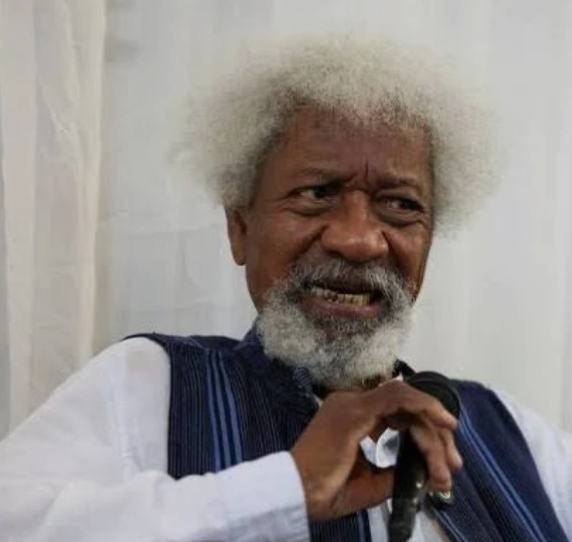
- Nobel laureate Prof. Wole Soyinka has condemned what he called the excessive deployment of security operatives around President Bola Tinubu’s family, warning that such overprotection distorts Nigeria’s security priorities.
Speaking at the 20th Wole Soyinka Centre for Investigative Journalism (WSCIJ) Awards in Lagos on Tuesday, Soyinka recounted a recent encounter with what he described as a “battalion-level” security detail assigned to the president’s son at a hotel in Ikoyi.
He said the number of heavily armed officers he saw initially made him think a film was being shot.
“I was coming out of my hotel and saw what looked like a film set,” Soyinka said. “A young man walked over to greet me. When I asked if they were filming, he said no. I looked around, and there was nearly a whole battalion occupying the premises.”
According to him, about 15 heavily armed officers formed the president’s son’s security cordon—an arrangement he found excessive and troubling.
“When I asked my driver who the young man was, he told me. I saw a SWAT team armed to the teeth—enough to take over a small neighbouring country like Benin,” he added.
Soyinka said the situation alarmed him so much that he attempted to reach the National Security Adviser (NSA) to confirm whether such deployment was authorised.
“I asked them to track down the NSA. They reached him somewhere in Paris, but he was in a meeting with the president. I described the scene and asked, ‘Does a child of the head of state really move around with an army?’ I couldn’t believe it.”
With a touch of sarcasm, Soyinka suggested that the government might not need the military to quell unrest in neighbouring countries when such a formidable force already escorts the president’s son.
“Tinubu doesn’t need to send the air force or the military anywhere. There’s a simpler option,” he said. “If there’s an uprising, the president should just call that young man and say, ‘Seyi, go and put them down. You already have troops.’”
He stressed that while presidents have families, such privilege must not be abused or allowed to distort national security architecture.
“Children should know their place. They are not potentates; they are not heads of state,” he said. “National security suffers when so much is devoted to one individual.”
Soyinka’s comments add to growing public concern over the scale of state security visibly assigned to politically connected individuals, especially at a time of widespread insecurity across the country.