



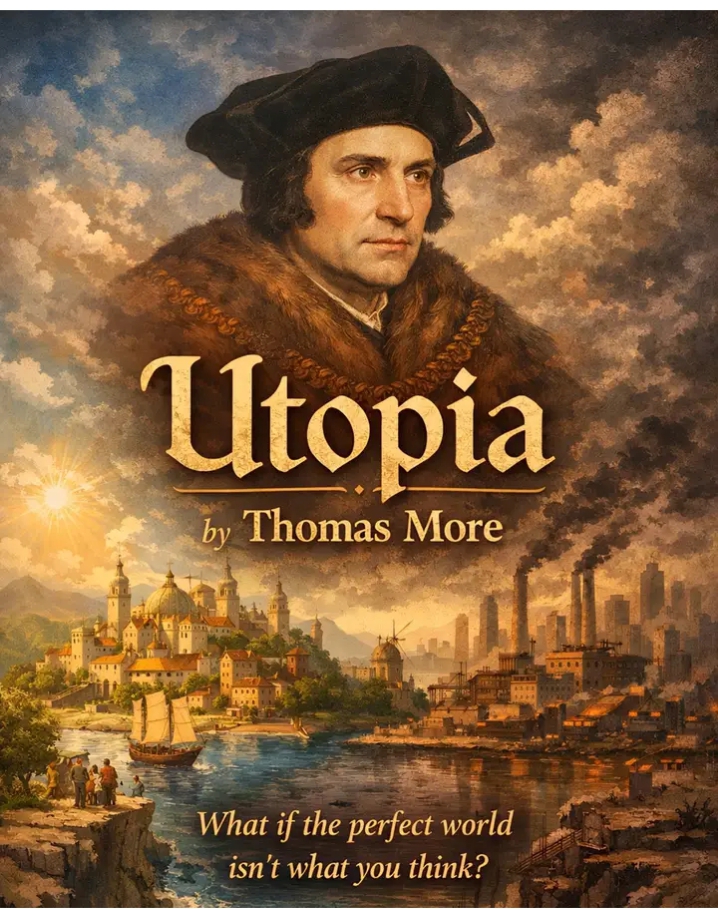
When Thomas More published Utopia in 1516, he could not have imagined a world of smartphones, global capitalism, or social media outrage. And yet, five centuries later, his strange island feels uncannily familiar. Utopia does not read like a dusty political treatise; it feels more like a sharp conversation overheard across time—one that still unsettles, provokes, and quietly accuses us.
At first glance, Utopia presents an ideal society: no private property, no extreme poverty, no idle luxury. Everyone works, education is valued, and laws are few because justice is simple. But beneath this calm surface lies a deep irony. More was not offering a neat blueprint for a perfect state; he was inviting readers to question their own assumptions about power, wealth, freedom, and happiness.
And that invitation feels especially urgent today.
A World Obsessed with Wealth vs. A Society That Questions It
One of More’s most radical ideas is the abolition of private property. In Utopia, gold is so meaningless that it is used to make chamber pots and chains for slaves. This symbolic reversal exposes a truth that still stings: societies often worship what ultimately enslaves them.
Now look at our world. We live in an age of unprecedented wealth—and unprecedented inequality. A small fraction owns more than entire nations, while millions struggle to survive despite working endlessly. Like the England of More’s time, our modern societies criminalize poverty rather than question the systems that produce it. Utopia dares to ask what we still avoid: Is endless accumulation really progress, or just a more polished form of injustice?
Work, Leisure, and the Illusion of Freedom
In Utopia, everyone works—but no one is overworked. The working day is short, leaving time for learning, reflection, and conversation. Contrast this with today’s “hustle culture,” where exhaustion is worn like a badge of honor and rest feels almost sinful.
We celebrate productivity, yet feel chronically empty. More’s island quietly challenges this contradiction. If technology has made life easier, why are we busier than ever? Utopia suggests that the problem is not work itself, but work divorced from human well-being—a concern that resonates strongly in an age of burnout and mental health crises.
Politics, Power, and the Fear of Truth
Utopian leaders are chosen for wisdom, not wealth. Political ambition is suspect, even dangerous. Compare this to modern politics, often dominated by spectacle, manipulation, and the pursuit of power for its own sake. Truth bends easily when profit or popularity is at stake.
Yet More does not idealize authority blindly. Utopia is also unsettling: conformity is expected, dissent is limited, and individuality is carefully controlled. This ambiguity is deliberate. More seems to whisper a warning across centuries: Even good intentions can become oppressive if they silence human complexity.
In a world increasingly polarized, where opposing views are shouted down rather than examined, this warning feels prophetic.
Religion, Tolerance, and Moral Balance
Remarkably, Utopia practices religious tolerance—an extraordinary idea for the 16th century. Different beliefs coexist peacefully, united by shared ethical values. In our supposedly enlightened age, religious and ideological intolerance still fuels conflict across the globe.
More’s vision reminds us that tolerance is not the absence of belief, but the presence of humility—the ability to admit that no single perspective owns the whole truth.
Is Utopia a Dream—or a Challenge?
Perhaps the most powerful aspect of Utopia is that it refuses to give easy answers. Even the word itself means “no place.” More leaves us uncertain: Is this society admirable or disturbing? Is perfection desirable—or even human?
That uncertainty is the point.
Utopia is less a destination than a mirror. It reflects our failures, exaggerates our values, and forces us to confront uncomfortable questions about the world we have built. In an era of climate anxiety, economic imbalance, and moral confusion, Thomas More’s work remains startlingly alive—not because it tells us what to think, but because it teaches us how to question.
And perhaps that is the most utopian idea of all.