


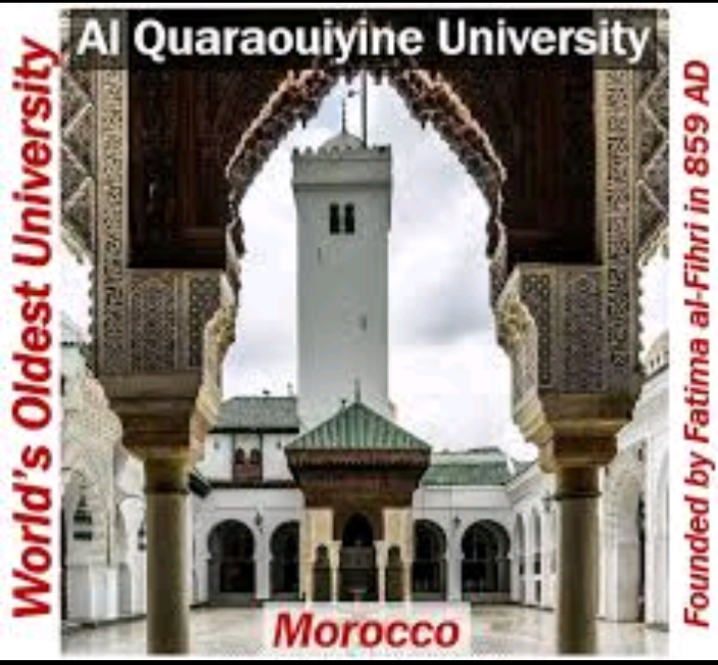
Two sisters inherited a fortune in 859 CE. One built the world’s oldest university. The other built a mosque. Both are still standing. Both were women.
In Tunisia, early 800s CE. Fatima and Mariam al-Fihri were born into wealth; their father was a successful merchant who had built a trading empire.
But wealth in 9th-century North Africa came with limitations if you were a woman. You could marry well. You could manage a household.
You could live comfortably in the shadows of male relatives.
You weren’t supposed to build institutions that would outlast empires.
The al-Fihri family moved to Fez, Morocco, when Fatima and Mariam were young. Fez was exploding with growth—refugees from Andalusia and Tunisia were pouring in, transforming it into a major cultural center.
Then came the deaths that changed everything.
First, Fatima’s husband died. Then Mariam’s husband. Then their father.
The two sisters—both young widows—inherited their father’s entire fortune.
In most societies at this time, male relatives would have controlled that wealth. Brothers, uncles, cousins—someone male would have managed the money while the women lived off allowances.
But Fatima and Mariam had different plans.
They looked at Fez filling with scholars, students, and refugees who had nowhere to study, nowhere to pray, nowhere to preserve the knowledge being lost as political turmoil swept through the Muslim world.
And they decided: We’ll build it ourselves.
Mariam chose to build the Al-Andalusiyyin Mosque—a place of worship for the Andalusian refugees who had fled persecution and needed a spiritual home in their new city.
Fatima chose something even more ambitious: she would build not just a mosque, but an entire institution of learning.
The University of al-Qarawiyyin.
Here’s what makes this extraordinary: Fatima didn’t just fund it. She didn’t just donate money and let men build it.
She personally oversaw the construction.
According to historical accounts, Fatima fasted during the entire construction period—refusing to eat until sunset each day as a spiritual commitment to the project. Some accounts say she didn’t break her fast until the entire building was complete and the first prayers were held inside.
Whether that’s literally true or not, it tells you something about how seriously she took this work.
The construction took years. Fatima invested her entire inheritance—everything her father had built, everything she’d inherited from her husband. All of it went into the walls, the courtyard, the library, the classrooms.
She was building something that would outlive her by a thousand years. She just didn’t know it yet.
Al-Qarawiyyin opened in 859 CE as a mosque and educational institution. But it quickly became something unprecedented: a comprehensive university.
Students came to study the Quran, yes. But also mathematics. Astronomy. Medicine. Chemistry. Geography. Philosophy. Music. Grammar.
The library collected manuscripts from across the Islamic world—texts that would have been lost forever if not preserved here. Some of those original 9th-century manuscripts still exist in the library today.
This wasn’t just religious education. This was what we would now call a liberal arts university—broad, interdisciplinary, intellectually rigorous.
And it was founded by a woman. In 859.
Let that sink in:
University of Bologna (often called Europe’s first university): founded 1088—229 years after al-Qarawiyyin
University of Oxford: teaching began around 1096—237 years later
University of Paris (the Sorbonne): founded 1150—291 years later
Fatima al-Fihri built a comprehensive university almost 300 years before Europe’s first universities existed.
The institution developed a formal system of academic credentials—students would study with recognized scholars and receive certificates (ijazah) confirming their mastery of specific subjects. This became the model for academic certification across the Islamic world.
The curriculum was extraordinary for its time. Al-Qarawiyyin became famous for:
Advanced mathematics and algebra
Astronomical observations and calculations
Medical texts and practice
Legal philosophy and Islamic jurisprudence
Literature and poetry
Music theory
Students came from across North Africa, the Middle East, and even Europe. Muslim, Christian, and Jewish scholars studied side by side.
Among the notable alumni:
– Muhammad al-Idrisi, the geographer whose 1154 world map was the most accurate for 300 years and guided European explorers
– Ibn Khaldun, considered the father of sociology and historiography
– Leo Africanus, the diplomat and author whose writings introduced much of Africa to European readers
– Pope Sylvester II (Gerbert d’Aurillac), who studied at al-Qarawiyyin and later introduced Arabic numerals to Europe
The influence spread far beyond Fez. Ideas developed at al-Qarawiyyin traveled along trade routes, influencing universities as they developed in Europe, shaping the Renaissance, preserving Greek and Roman texts that would have been lost.
Knowledge that Fatima’s university preserved helped pull Europe out of the Dark Ages.
And through it all, for over 1,100 years, the institution has never stopped operating.
Think about that timeline:
– 859: Fatima founds al-Qarawiyyin
– 1066: Norman Conquest of England (al-Qarawiyyin already 207 years old)
– 1492: Columbus reaches Americas (al-Qarawiyyin: 633 years old)
– 1776: American Revolution (al-Qarawiyyin: 917 years old)
– 1945: End of World War II (al-Qarawiyyin: 1,086 years old)
– 2025: Today (al-Qarawiyyin: 1,166 years old and still teaching students)
Empires have risen and fallen. Technologies have been invented and abandoned. Entire civilizations have come and gone.
And the university Fatima built still stands.
But here’s what really gets me: For most of those 1,100+ years, Fatima al-Fihri’s name was barely mentioned.
The university was famous. The scholars were celebrated. The library was renowned.
But the woman who built it? Footnoted. Sometimes erased entirely.
It wasn’t until the 20th century that historians started seriously examining her role and recognizing that al-Qarawiyyin wasn’t just another mosque expansion—it was a deliberate, ambitious institution of higher learning built by a woman who understood that education was the most important investment she could make.
– UNESCO officially recognized al-Qarawiyyin as the oldest continuously operating university in the world.
– The Guinness Book of World Records confirmed it.
And finally—finally—Fatima al-Fihri began getting credit for what she built.
In 2014, Moroccan architect Aziza Chaouni led a restoration project of the library—a woman restoring the library another woman built 1,155 years earlier.
When they opened the ancient library to researchers, they found 9th-century manuscripts that had been there since Fatima’s time. Books she might have touched. Knowledge she preserved.
Today, al-Qarawiyyin is integrated into Morocco’s modern university system. It grants degrees recognized internationally. Students still attend classes in buildings that have stood for over a millennium.
And Fatima’s sister? Mariam’s mosque—the Al-Andalusiyyin—still stands too. Still active. Still serving the community.
Two sisters. Two massive construction projects. Both still functioning 1,166 years later.
Both built by women who were told to live quietly on their inheritances.
Instead, they built legacy.
Here’s what Fatima and Mariam understood that we sometimes forget: wealth is temporary. Buildings decay. Empires crumble.
But knowledge—real, accessible, transformative knowledge—can survive anything.
The sisters could have lived luxuriously. They could have remarried into powerful families. They could have funded comfortable, safe, small projects.
They chose to build institutions so large, so ambitious, so enduring that they would still be teaching students over a thousand years later.
Fatima al-Fihri didn’t write books that survive. We don’t have her journals or letters. We don’t know exactly what she looked like or what her voice sounded like.
But we have her university.
We have the knowledge it preserved.
We have the scholars it trained.
We have the ideas it spread across continents.
And most importantly: we have proof that a woman in 859 CE understood something that took the rest of the world centuries to figure out.
That education is the most powerful force for change.
That institutions of learning can outlast kingdoms.
That knowledge shared freely creates civilizations that endure.
She was a widow. In 859 CE. In North Africa.
She built the world’s oldest continuously operating university.
And it’s still teaching students today.
That’s not just legacy. That’s immortality.