


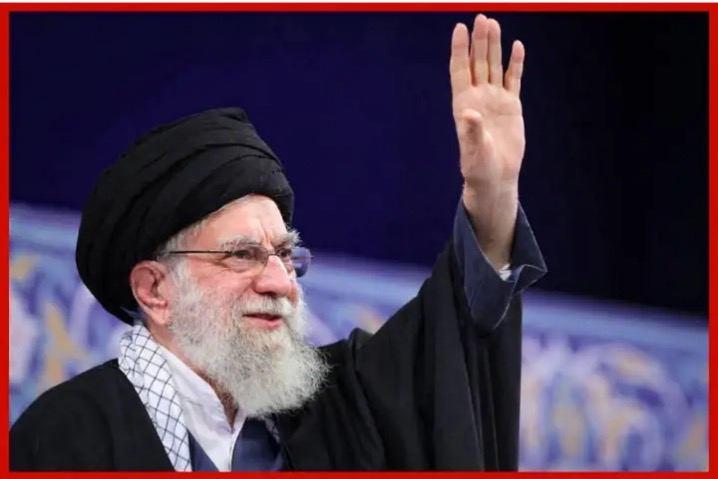
This is an interview given by an American journalist, Mr. Scott, after the martyrdom of the Leader. Mr. Scott was once a commander in the U.S. Army, but later left the military and entered the world of journalism. He spoke in such a candid and powerful way that anyone who understands English or the American accent only needs to listen to the first twenty minutes of his interview—their entire perspective would change.
After the martyrdom of the Leader, a question had been troubling thousands of minds, including mine: why, in such dangerous and tense circumstances, was he sitting in an ordinary, unprotected house with his family members and some of his closest companions?
This question disturbed me deeply. But this American journalist lifted the veil from that reality so beautifully that it left one astonished.
In my view, what Mr. Scott has done through this interview is something even a hundred Iranian missiles falling on New York could not have achieved. Undoubtedly, millions in America must have listened to him. It feels like a declaration of Iran’s moral victory and the early fruit of the Leader’s sacrifice. Usually, divine truths take time to become clear, but the blood of the oppressed Syed seems to have spoken even before his burial—truth emerging from the tongue of the opponent.
There is a striking resemblance, he said, between the way Imam Hussain took his family to the desert of Karbala and embraced martyrdom, and the way the Leader sat in a simple house with his family and close companions—accepting sacrifice so that his sacred blood might ignite in the hearts of believers a spirit against falsehood that guarantees the protection of truth. Allahu Akbar.
Scott openly said that Donald Trump is a foolish man and that by killing Ali Khamenei, he has sealed his own defeat. He explained that Americans are familiar only with Wahhabi Islam, which they themselves have promoted, but they are largely unaware of Shia Islam—an Islam that speaks of humanity, unity, and brotherhood, and is rooted in sacrifice.
According to Scott, the heroes of this Islam are Muhammad, Ali, and Hussain. The martyrdom of Ali and Hussain is its treasure. In this tradition, whoever is martyred for a higher cause rises to the rank symbolically associated with Ali and Hussain. By killing Ali Khamenei, Trump has, in Scott’s words, turned him into a Hussain-like figure in the hearts of millions of Shias and shattered his own “regime change” formula.
Scott further said that just as Hussain stood against the tyrant of his time and, by embracing martyrdom with his family in a barren desert, ultimately defeated oppression—because there was no other path left—similarly, Ali Khamenei, by accepting martyrdom with his family, has buried the regime-change project in dust.
He predicted that Trump will not be able to save his government; that change will soon come within America itself, and that Trump will be removed from power in disgrace. He added that America can sustain this war for at most two weeks before its resources and weapons are exhausted, while Iran can fight for years. According to him, America is heading toward serious difficulty.
Another significant point he made was that America wanted to prevent Iran from developing nuclear weapons. Yet, he argued, Trump eliminated a man who, from an Islamic perspective, was opposed to building an atomic bomb and had even issued a religious decree against it. Now, the leadership that may emerge could support building such weapons if necessary—so what, he asked, has Trump truly achieved?
He claimed that there had already been an understanding between Iran and America regarding not building nuclear weapons, and that it only required technical finalization. Trump could have presented that as a diplomatic success to the American people. Instead, under Israeli pressure, he attacked Iran and sealed his own failure.
Scott also made a striking admission: “We Americans are foolish people, and we are dealing with an extremely intelligent Iranian nation.”
He spoke about the institution of Marja’iyyah in Shia Islam, describing it as a profound system of religious authority and guidance that cannot be attained casually. It requires years upon years of rigorous Islamic scholarship, and only those who truly prove themselves worthy reach that position. He pointed out that no equivalent institution exists in Sunni or Wahhabi Islam.
He emphasized that Shia Islam speaks of humanity and does not hesitate to sacrifice for the betterment of mankind.
He also mentioned Bahrain, whose majority population is Shia but is ruled by a Sunni government. He claimed that when Iranian missiles land there, Shia citizens come out into the streets celebrating. He further said that many Arab states are now in distress, and that Israel’s defensive system is steadily weakening.
This interview, to the speaker, feels like a hammer striking the head of falsehood.
The blood of the مظلوم Syed will bear fruit. Just as his grandfather Imam Hussain, through his blood, cut the lifeline of tyranny—so too, they believe, has this sacrifice shaken the very foundations of falsehood.