


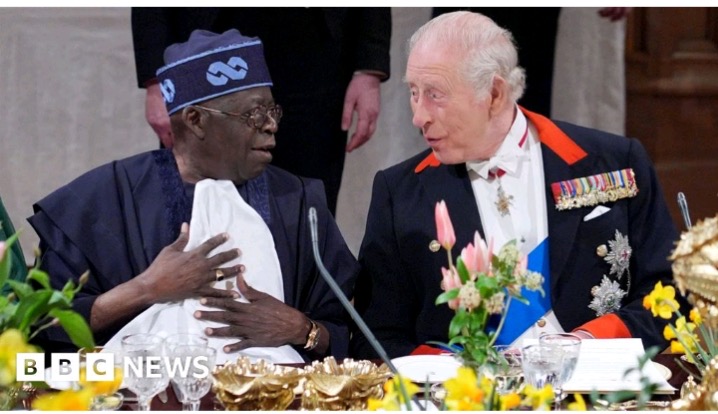
I did not know President Tinubu was in London until images of his entourage began to circulate on Wednesday, March 18, 2026. Ministers, senators, and top political appointees—smiling—being conveyed in horse-drawn carriages. That was when it became clear: this was no ordinary trip, but a state visit.
What makes the optics troubling is the timing. The visit came barely two days after coordinated suicide bombings in Maiduguri that killed at least 23 people and left over 100 injured. The attacks struck crowded areas shortly after the breaking of the Ramadan fast on March 16, 2026.
Yet, far from the grief at home, Nigeria was celebrated and signing deals abroad.
One of the major outcomes of the visit was the securing of a £746 million (about ₦1.38 trillion) infrastructure loan from the United Kingdom to modernise the Apapa and Tin Can Island ports. An addition to our rising debt profile. The financing, backed by UK Export Finance and coordinated through Citibank, is tied to contracts—amounting to at least £236 million—awarded to British firms.
Included in these contracts is a groundbreaking £70 million (about ₦129 billion) deal for British Steel to supply 120,000 tonnes of steel billets for the port upgrades. It is being celebrated as one of the company’s largest export orders.
But this raises a fundamental question: why is Nigeria importing steel on this scale while Ajaokuta Steel lies dormant?
This is not just an economic contradiction—it is a policy failure.
British Steel itself was on the brink of collapse not long ago. By 2022, it had accumulated losses exceeding £400 million, and its primary production facilities faced imminent shutdown. In response, the British government acted decisively.
It committed significant investment into the sector that included a £2.5 billion package in 2023 to support the transition to “green steel” technologies. In April 2025, Parliament passed the Steel Industry (Special Measures) Bill in a single day, taking emergency control of the company to preserve 3,500 jobs and protect domestic steel capacity.
That is what political will looks like.
Today, Nigeria is effectively helping to sustain that revived industry by importing 120,000 tonnes of steel—while its own steel backbone remains abandoned.
Who, then, will save Ajaokuta?
The implications go beyond this single contract. Nigeria continues to spend billions annually importing steel, including for large-scale infrastructure such as concrete roads. One cannot help but imagine the multiplier effect if even a fraction of that demand were met locally through Ajaokuta and Delta Steel.
The issue is not ignorance. It has been identified—clearly and repeatedly.
Senator Natasha Akpoti-Uduaghan has consistently drawn attention to the crisis. On February 27, 2024, less than four months after reclaiming her mandate, she raised a motion in the Senate, pointing to political will and bureaucratic corruption as the central reasons for Ajaokuta’s continued paralysis.
She questioned the reported $496 million payment made in 2022 to Global Infrastructure Holdings Ltd over contractual disputes and highlighted a deeper national tragedy: Nigeria spends about $3.3 billion annually importing steel despite possessing abundant iron ore resources.
Her words were direct and damning—Ajaokuta and Delta Steel have become channels for the misappropriation of public funds rather than engines of industrial growth.
The Senate responded by constituting a 10-member ad hoc committee to investigate the matter, including the state of Ajaokuta and the National Iron Ore Mining Company (NIOMCO).
Two years later, there is little to show for it.
No revival. No accountability. No strategic shift.
Instead, Nigeria is taking loans to import steel.
The British government intervened in their steel sector to save jobs and protect domestic steel capacity. The successive Nigerian government is playing games with our steel sector that could have created a lot of jobs and opportunities. The few steelworkers at the complex and their boss are paid to watch the complex decay.
At this point, the question is no longer whether Ajaokuta can work. The real question is whether there is a deliberate choice not to make it work.
Because nations that understand the strategic importance of steel do not abandon it—they fight for it.
Britain did.
Nigeria, it seems, is choosing not to.
So we must ask, plainly and without sentiment:
Has Ajaokuta Steel been committed to a deliberate death?
Is that the promised “Renewed Hope”?
Is that the mandate we are standing on for 2027?
Happy birthday to President Bola Ahmed Tinubu!
©️Amoka