


By Dele Omoyuyigbe
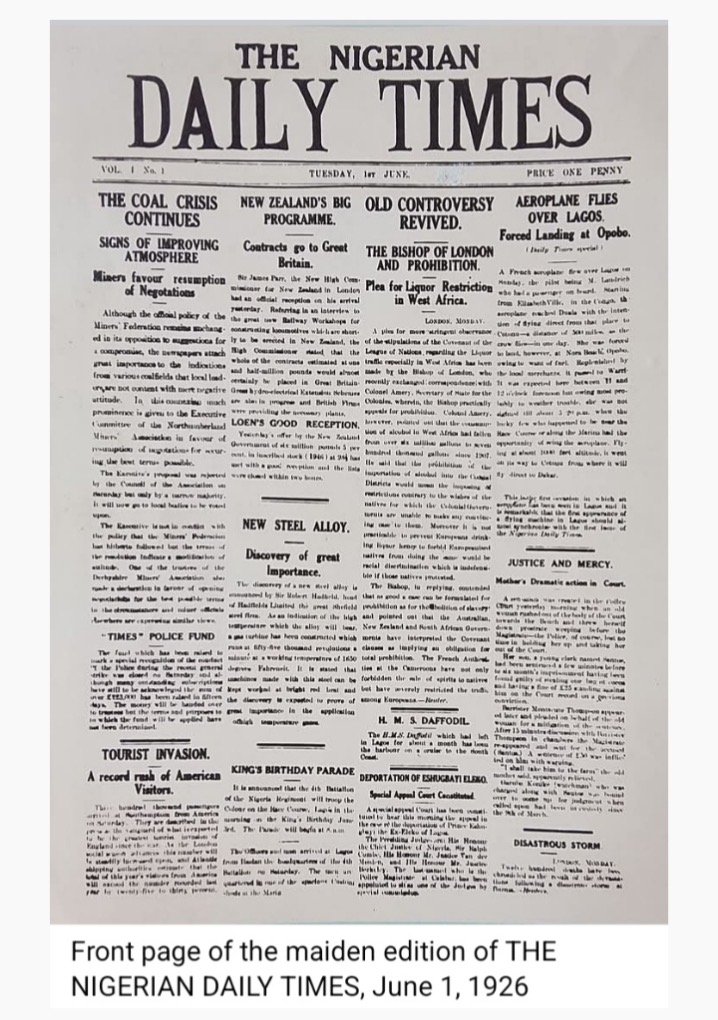
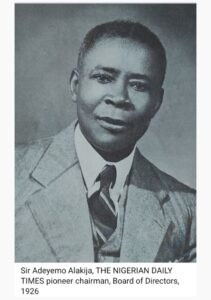
This day 100 years ago, the maiden edition of THE NIGERIAN DAILY TIMES hit the newsstands. 2000 copies of the paper were rolled out of the press for sale, an effort which crowned restless months of rigorous planning by its Board of Directors chaired by Sir Adeyemo Alakija. Later known as DAILY TIMES, the publication debuted as THE NIGERIAN DAILY TIMES with just four pages.
Of less concern then was its crowded front page which featured 13 stories without a single photograph. Everywhere was grey and eye-straining. That wouldn’t matter though as readers were delighted to see and hold the first daily newspaper in the country. “It is generally agreed that, considering the importance of Nigeria, both commercially and in other respects, a daily sheet however meagre, embodying the main features of a daily newspaper, had for some time been felt as a real need in the country. This is fully justified by the enthusiasm with which the public has greeted the announcement of the birth of the Times”, the paper wrote in its first editorial.
Reiterating its pursuit of an exclusive mission, the newspaper led readers further into its unique persona – to break new grounds in local journalism and push forward informed opinion without attachment to a particular creed or party. “Except, occasionally, and in particular, grave matters, we shall, perhaps for several years to come, maintain a detached attitude towards local politics which has never up to now risen above petty personal squabbles. The bigger problems which affect Nigeria as a whole will be our immediate concern”, the paper wrote.
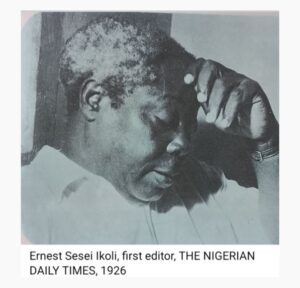
Its pioneer editor, Mr Ernest Sesei Okoli, who before then was the publisher and editor of THE AFRICAN MESSENGER, was hired via headhunting. The directors needed a popular and brave news manager who could pursue the newspaper’s policies vigorously, and they found Ikoli, a thoroughbred professional from River State, acclaimed to be imbued with untainted conscience.
Ikoli accepted the offer, but as described, he counselled his new employers to do something about his status, as it would be unfair to keep his job as publisher of THE AFRICAN MESSENGER when he would be drawing his salary from THE NIGERIAN DAILY TIMES. In consideration, THE NIGERIAN DAILY TIMES Board decided to pay him N1,000 from the profit of THE AFRICAN MESSENGER within a year and another N1,000 within three years for him to remain committed to his new job. Ikoli gave his word not to publish within five years so as not to jeopardize the future of the nascent THE NIGERIAN DAILY TIMES.
The first edition of the paper on June 1, 1926 was a huge success and the editor reflected on his staff’s colossal sacrifice to make that happen. “Very often, it was 18 working hours a day for some of us. But in spite of the long hours and depressing conditions, there was always an air of cheerfulness and enthusiasm” he said. The stress possibly caused the glaring omission of date in that first edition (See photo).
Ikoli evoked the experience of the first day of THE NIGERIAN DAILY TIMES. “I always recall the great excitement we felt that early morning of June 1, 1926 when 2000 copies of THE NIGERIAN DAILY TIMES had been printed ready for sale in the streets of Lagos and for distribution to other parts of Nigeria”, he said. “Those who are old enough to remember will understand why it was looked at as a crazy thought to want to start a daily newspaper here in those days. The idea was laughed at and there were whispered predictions of immediate failure”, he added.
An apartment at No 172 Broad Street Lagos, a dwelling structure of four bedrooms on either side, housed the paper’s pioneer staff. The building had no ventilation but for a narrow window which separated the house from the next, the editor stated. “As managing editor, I chose the best room with its one window. Here a desk was installed and a shelf for books and papers hastily arranged. The late Adebayo Omololu, then my assistant, and one or two junior men, occupied the other room next to mine. The other members of the staff, managerial and clerical, were assigned to the two unventilated rooms. They did not appear to mind it very much”, the editor said.
Reliving the early days more, Ikoli narrated, “All typesetting was done by hand and these type cases were scattered all over the place, and compositors had to carry on in all sorts of postures, standing, sitting, crouching wherever there was any little space available, while some set their types in the open”. In the end, THE NIGERIAN DAILY TIMES was born.
Aligning strongly with the vision of the newspaper’s board of directors, the editor added the paper’s voice to the clamour for Nigeria’s independence. But as if waiting for that dream to materialise, Ikoli died on October 21, 1960 at the age of 77, barely three weeks after Nigeria got the independence.