


By Adeleke Nurudeen Adepoju
Al-Habibiyyah Islamic Centre is steadily emerging as a leading faith-based platform for education, innovation, philanthropy and sustainable development in Nigeria, as it continues to forge strategic partnerships with reputable institutions and research-driven organizations locally and internationally.
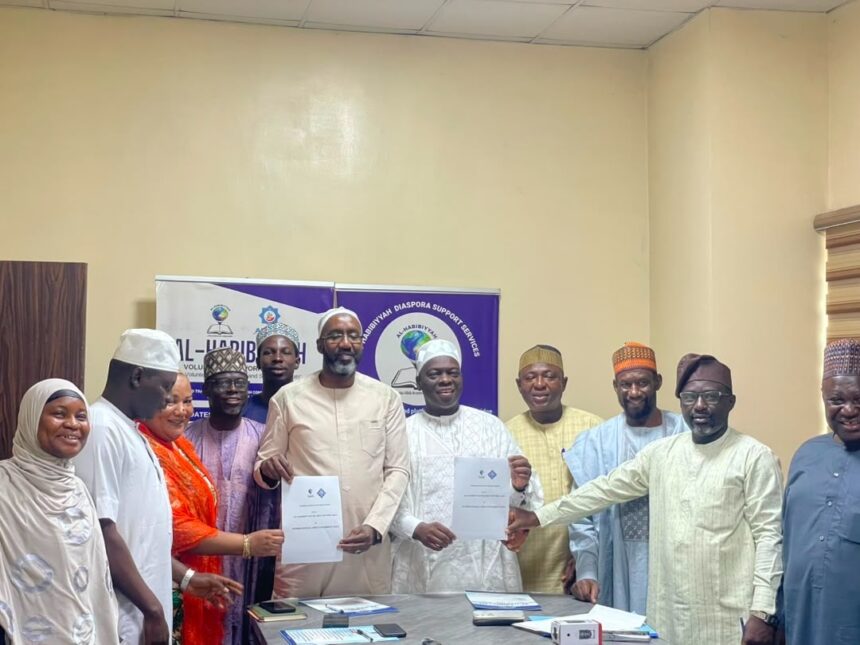
In furtherance of this vision, Al-Habibiyyah Islamic Centre has signed a Memorandum of Understanding (MoU) with the International Open University (IOU), Gambia, marking another significant milestone in its commitment to expanding access to quality education, professional development and human-capacity building within the Islamic community and beyond.
The MoU was signed on behalf of Al-Habibiyyah Islamic Centre by its National Chief Imam and Executive Director, Imam Fuad Adeyemi, while Professor Maki Taal, Vice Chancellor of the International Open University, signed on behalf of IOU. The signing underscores the shared commitment of both institutions to strengthening access to quality education, knowledge exchange and sustainable human-capital development.
The partnership comes barely a week after Al-Habibiyyah Islamic Centre entered into a strategic collaboration with FIUSS, a Malaysian technology company, to advance innovation in Waqf and blockchain technology in Nigeria. That partnership is aimed at helping to redefine the future of Islamic philanthropy, sustainable development and Shariah-compliant financial innovation.
The latest collaboration with IOU further demonstrates the Centre’s strategic direction of leveraging partnerships, technology and knowledge to create sustainable opportunities for individuals and communities.
Expanding Access to Quality Education
The International Open University, Gambia, is a technology-driven institution offering flexible online education designed to make quality learning accessible to students regardless of geographical location. Its digital learning model allows students to determine the pace and structure of their studies while benefiting from online instruction and academic support from qualified instructors.
The University offers a broad range of academic programmes spanning certificate, undergraduate and postgraduate studies, providing learners with opportunities to acquire academic qualifications and develop professional competencies.
Among its undergraduate programmes are Business Administration, Information Technology, Islamic Economics, Banking and Finance, and Psychology, among others.
The partnership therefore presents an opportunity to bridge the gap between faith, education, technology and professional development, while opening new pathways for members of the community to acquire relevant knowledge and qualifications in an increasingly digital global economy.
Scholarship Opportunities and Human Capital Development
A key component of the MoU is the creation of scholarship opportunities for eligible beneficiaries, providing pathways for students and aspiring professionals to pursue further education and acquire relevant academic and professional qualifications.
Through this initiative, Al-Habibiyyah Islamic Centre seeks to contribute to the development of a more educated, skilled and economically empowered community, while ensuring that financial constraints do not unnecessarily prevent deserving individuals from accessing quality education.
The collaboration will also provide a framework for sustained institutional engagement between Al-Habibiyyah Islamic Centre and IOU, potentially covering areas of education, knowledge exchange, capacity building, professional development and other mutually beneficial initiatives.
Building a Knowledge-Driven Future
Speaking on the significance of the partnership, the National Chief Imam and Executive Director of Al-Habibiyyah Islamic Centre, Imam Fuad Adeyemi, described the MoU as another important milestone in the Centre’s evolving strategy of building partnerships that translate knowledge, technology and Islamic values into tangible opportunities for human and societal development.
The Centre believes that sustainable development within the community requires more than charitable intervention. It requires education, skills, innovation, access to opportunities and institutions capable of developing human capital for the future.
The partnership with IOU is therefore positioned within Al-Habibiyyah’s broader commitment to making education and capacity development central pillars of its community-development agenda.
With its expanding network of partnerships, Al-Habibiyyah Islamic Centre is positioning itself as a platform where faith, education, technology, philanthropy and sustainable development converge to create lasting impact.
The Centre remains committed to building strategic alliances with credible institutions across Nigeria and internationally, with the ultimate objective of empowering people, strengthening communities and contributing meaningfully to national development.