


By Abdulquadir Abdulwahid | October 1, 2026
And Allah presents an example: a town that was secure and peaceful, its provision coming to it abundantly from every direction, but it denied the favours of Allah. So Allah made it taste the envelopment of hunger and fear because of what they used to do. – Qur’an 16:112
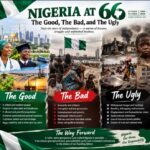
Today, Nigeria marks 66 years of independence.
There will be flags. There will be speeches. There will be prayers. There will be celebrations.
But perhaps Independence Day should also be a day of national reflection.
Not only: What have we achieved?
But, What have we become?
And even more importantly, What are we doing with what Allah has entrusted to us?
Qur’an 16:112 presents the picture of a community that possessed three remarkable blessings: security, tranquility and abundant provision. Its tragedy was not that it had nothing. Its tragedy was that it failed to properly appreciate and steward what it had.
This verse is not a direct description of Nigeria, nor should we casually declare that every Nigerian difficulty is a divine punishment. The Qur’an, however, gives us a powerful moral framework for examining how societies respond to blessings, responsibility, injustice and wrongdoing.
And when we look at Nigeria, the question becomes uncomfortable.
A COUNTRY BLESSED WITH MUCH
Nigeria is not a nation without resources.
We have oil and gas. We have enormous agricultural potential. We have a large youthful population. We have entrepreneurs building businesses under difficult conditions. We have academics, doctors, engineers, teachers, artisans, religious scholars, creatives and professionals making contributions at home and abroad.
Nigerians have demonstrated extraordinary capacity.
The problem, therefore, cannot simply be described as lack of potential.
The deeper question is how effectively we convert potential into public wellbeing.
The World Bank continues to identify poverty, limited access to economic opportunity, weak human capital and insecurity among the structural challenges affecting Nigeria. The IMF’s 2026 Article IV consultation confirmed that poverty reached 63 percent under the national poverty line, with approximately 27 million Nigerians estimated to have faced food insecurity in the fall of 2025. The Fund cautioned that “conditions remain difficult for many Nigerians, with poverty and food insecurity likely to worsen in the current external environment.”
That is where the Qur’anic concept of stewardship becomes important.
A blessing is not only something to enjoy. It is an amanah.
WHEN CORRUPTION BECOMES MORE THAN STEALING MONEY
Corruption is often reduced to politicians stealing public funds.
That is too narrow.
Corruption is also the teacher who sells examination integrity. The official who demands money before performing a public duty. The contractor who receives payment for work that was never properly delivered. The businessman who deliberately deceives customers. The person who manipulates a process because he knows someone. The citizen who complains about corruption but celebrates it when it benefits him.
This is why corruption is ultimately a culture of dishonesty and abuse of trust, not merely a financial crime.
Allah says:
Indeed, Allah commands you to render trusts to whom they are due.
— Qur’an 4:58
Public office is an amanah. A government contract is an amanah. A scholarship is an amanah. A classroom is an amanah. A leadership position in a mosque or community is an amanah. Even the small responsibilities that nobody sees are amanah.
When trust disappears, development becomes expensive. Money disappears. Projects fail. Institutions weaken. Citizens lose confidence. And ultimately, the ordinary person pays the price.
In May 2026, Nigeria witnessed a stark illustration of this reality. Saleh Mamman, a former Minister of Power, was sentenced in absentia to 75 years in prison for diverting approximately N33.8 billion meant for the Zungeru and Mambilla hydroelectric power projects. The court found that he used proxy companies and associates to siphon funds intended for critical national infrastructure. After going underground, he was arrested in Kaduna following weeks of intelligence operations.
The funds diverted from those power projects could have illuminated homes, powered businesses, and created opportunities. Instead, they became a case study in how public trust is betrayed.
INSECURITY: WHEN FEAR ENTERS THE HOME
The verse mentions al-ju’ and al-khawf — hunger and fear.
Nigeria understands both words.
Families have lost loved ones to terrorism, banditry, kidnapping, communal violence and criminality. Farmers have faced insecurity in some parts of the country. Businesses have been disrupted. People have become afraid of travelling on roads that should connect communities. Parents worry about their children. And young people grow up in environments where violence can sometimes appear normal.
The data is devastating. According to SBM Intelligence, at least 7,825 people were abducted in Nigeria between July 2025 and June 2026 across 1,713 incidents, while at least 1,142 were killed. Ransom payments totalled approximately $5.8 million — more than three times the amount paid in the previous period. Two mass kidnappings attributed to Boko Haram accounted for nearly 90 percent of that total: the abduction of 416 people, mostly women and children, from Gwoza in Borno State, and the kidnapping of 303 children and 12 teachers from St. Mary’s Catholic School in Niger State.
Zamfara State alone recorded 236 kidnapping incidents and 1,921 victims — about one-quarter of the national total.
But insecurity is not merely a security problem. It is an economic problem. It is an educational problem. It is a psychological problem. It is a development problem.
When people cannot move safely, trade suffers. When farmers cannot farm safely, food production suffers. When schools become unsafe, education suffers. When businesses operate under fear, investment suffers. When communities lose trust, social cohesion suffers.
A nation cannot fully prosper when too many of its citizens are afraid.
THE HUNGER BEHIND THE STATISTICS
Nigeria’s cost of living crisis cannot be discussed only in numbers.
Behind inflation statistics is a mother calculating what she can remove from the shopping list. Behind rising food prices is a father wondering how to feed his children. Behind unemployment statistics is a graduate questioning the value of years spent in school. Behind poverty figures is a family deciding which need must wait until tomorrow.
The macro numbers tell a story of stabilisation: headline inflation eased to 15.43 percent in July 2026 from 24.94 percent a year earlier. The IMF projects real GDP growth of 4.1 percent in 2026.
But those numbers mask a deeper reality. Food inflation accelerated to 20.31 percent year-on-year in July 2026 from 17.52 percent in June. The cost of a healthy diet rose to N1,589 per adult per day in April 2026, up 4.68 percent from a year earlier. Undernourishment increased from 10.8 percent in 2015–2017 to 19.9 percent in 2022–2024.
In 19 states and the Federal Capital Territory, inflation exceeded 30 percent in June 2026. Kogi State recorded food inflation of 53.02%. Niger State recorded headline inflation of 42.23%.
Strategy&’s H2 2026 Nigeria Economic Outlook concluded bluntly: “Poverty rates remain elevated and are projected to remain broadly unchanged in 2026, indicating limited gains from the recent macroeconomic stabilization.”
The World Bank’s Country Partnership Framework for 2026–2032 found that 79 percent of Nigerians are either poor or vulnerable to falling into poverty — 33 percent ultra-poor (food insecure by caloric intake), 61 percent below the poverty line.
A Reuters investigation captured the human reality: “It costs Nigerians more than double to make the staple jollof rice than it did when Tinubu took office.” Petrol prices are six times higher. A health NGO worker earning nearly double the minimum wage said her salary “stays with me just for one week.”
Economic reforms can be necessary. But reform must ultimately be judged by what it does to human lives.
A successful economy is not simply one in which macroeconomic indicators improve. It is one in which people increasingly have productive work, purchasing power, dignity and reasonable hope for the future.
OUR GREATEST RESOURCE MAY BE OUR YOUNG PEOPLE
Nigeria is young.
That can become either our greatest demographic advantage or one of our greatest sources of instability.
A young person without education, employment, mentorship and hope becomes vulnerable to exploitation. A young person with knowledge, skills, opportunity and purpose becomes an engine of development.
This is why youth unemployment and underemployment are not merely economic concerns. They are questions of national security and social stability.
There are signs of institutional response. The Federal Government has equipped 239,726 Nigerian youths with digital, employability and practical skills through the Nigerian Youth Academy, with 1,215,203 certificates downloaded from the platform. Through NiYA StartUp, 200 young business owners received N1 million each, while another 200 in the informal sector received N500,000 each. A partnership with the Digital School, supported by the UAE government, targets 50,000 youths for globally competitive digital skills training, with at least 5,000 internationally certified and job-ready within six months.
These are meaningful steps. But scale matters. Millions of young Nigerians remain outside these programmes. The question is whether such initiatives can become systemic rather than episodic.
We should stop discussing young people only as beneficiaries. Young people are development actors.
Give them quality education. Give them vocational and digital skills. Give them access to finance. Give them mentorship. Give them opportunities to participate. Give them the dignity of meaningful work.
Do not merely tell young people to avoid crime. Build a society in which honest achievement is possible.
EDUCATION: THE FOUNDATION WE CANNOT NEGLECT
A nation cannot rise permanently above the quality of its education system.
Education determines the quality of our workforce. It influences civic consciousness. It strengthens innovation. It develops critical thinking. It creates social mobility.
But education must not be reduced to obtaining certificates. Nigeria needs education that produces people who can think, create, solve problems, communicate, work and serve ethically.
The child in a rural school deserves quality education just as much as the child in an elite urban school. The teacher deserves proper preparation and support. The university student deserves an education that connects learning with opportunity. And the young person who cannot attend university deserves access to respected technical and vocational pathways.
A country that neglects education eventually pays for it through unemployment, inequality, insecurity and lost productivity.
THE CRISIS OF INEQUALITY
Nigeria’s challenge is not simply that some people are wealthy.
Inequality becomes dangerous when people’s opportunities are determined overwhelmingly by where they were born, who they know, their socioeconomic background or their access to power.
Two young Nigerians can have equal intelligence but completely different futures because one was born into opportunity and the other into deprivation.
That should concern us.
Islam does not ask society merely to admire wealth. It asks society to protect dignity.
Zakat, sadaqah, waqf and other mechanisms of Islamic social finance demonstrate that wealth carries social responsibility.
But philanthropy cannot replace good governance. Charity can feed a hungry person today. A functioning economy can help prevent that person from remaining permanently dependent.
We need both compassion and systems.
OUR RELIGIOUS INSTITUTIONS MUST ALSO ASK DIFFICULT QUESTIONS
Nigeria is deeply religious.
Mosques are full. Churches are full. Religious programmes are widespread.
Yet religious identity alone has not eliminated corruption, violence or injustice.
That should make religious leaders reflect.
Our sermons must produce character. Our schools must produce competence. Our institutions must demonstrate accountability. Our charity must preserve dignity. Our leadership must demonstrate amanah.
Religion must not become something we practise only in places of worship while abandoning its ethical demands in offices, businesses and publiChurchesm
The Qur’an does not teach us merely to perform rituals. It teaches us to establish justice.
Indeed, Allah commands justice and excellence.
— Qur’an 16:90
GOVERNMENT HAS RESPONSIBILITY, BUT CITIZENS DO TOO
It is easy to blame government for everything.
Government carries enormous responsibility, particularly for security, infrastructure, institutions, economic management and public services.
But citizens also have responsibilities.
We cannot demand an honest government while bribing officials. We cannot condemn corruption while looking for ways around legitimate procedures. We cannot demand justice while supporting injustice when our friend or relative benefits. We cannot complain about insecurity while financing or protecting criminals.
National transformation requires both institutional accountability and personal responsibility.
WHAT THEN IS THE PATHWAY FORWARD?
Nigeria does not need another collection of beautiful Independence Day slogans.
We need a culture of amanah, competence and accountability.
We need institutions that work. We need transparent management of public resources. We need justice that is credible and accessible. We need security that protects ordinary citizens. We need an economy that creates productive employment. We need education that produces capability. We need agriculture that can feed the nation and provide livelihoods. We need infrastructure that supports businesses and communities. We need social protection that reaches vulnerable people. We need religious and traditional institutions that model integrity.
And we need young people who understand that their future cannot be built entirely by waiting for government.
Entrepreneurship. Skills. Education. Innovation. Community service. Responsible leadership.
These must become part of the Nigerian pathway forward.
FROM INDEPENDENCE TO RESPONSIBILITY
Sixty-six years after independence, perhaps our greatest question is not whether Nigeria has failed or succeeded.
Reality is more complicated than either conclusion.
Nigeria has achieved much. Nigeria has also lost opportunities. Nigeria has produced extraordinary people. Nigeria has also tolerated extraordinary failures. Nigeria has experienced periods of progress and periods of serious difficulty.
The honest position is to acknowledge both.
But Qur’an 16:112 gives us something more valuable than nostalgia.
It gives us reflection.
A nation must examine what it does with its blessings.
What do we do with our natural resources? What do we do with public money? What do we do with our young population? What do we do with our educational institutions? What do we do with our diversity? What do we do with our religious traditions? What do we do with the trust placed in our leaders?
And what do ordinary citizens do with the small responsibilities placed in their hands?
Because national transformation does not begin only in the presidential office.
It begins wherever amanah is being exercised.
In the classroom. In the civil service. In the marketplace. In the farm. In the mosque. In the church. In the family. In the boardroom. In the street. In the voting booth. In the way we treat another human being.
NIGERIA’S NEXT CHAPTER
October 1 should therefore be more than a celebration of independence.
It should be a moment of national accountability.
Let us celebrate Nigeria. But let us also examine Nigeria.
Let us acknowledge our progress without hiding our failures. Let us criticize our problems without losing hope. Let us demand accountability without becoming cynical. Let us hold leaders responsible without abandoning our own responsibilities.
And let us remember that the Nigeria we desire will not be created by government alone.
It will be created by millions of Nigerians making better decisions with the responsibilities entrusted to them.
The Qur’an says:
Indeed, Allah does not change the condition of a people until they change what is within themselves.
— Qur’an 13:11
Perhaps that is the most important Independence Day message.
Nigeria does not only need a change of policies. It needs a renewal of character, institutions, responsibility and collective purpose.
We have resources. We have people. We have ideas. We have faith. We have history. We have enormous potential.
What we must now build is the discipline to steward these blessings properly.
Nigeria at 66: the question is no longer only what independence gave us. The question is what we, as a people, will do with the nation entrusted to us.
Abdulquadir Abdulwahid is a volunteer with Al-Habibiyyah Islamic Society. He writes on governance, faith and national development. He can be reached at Abdulquadirbamidele@gmail.com