


… and “Precision Revenge” Missiles Emerge from the “Secret City”
By Talal Nahle
Strategic Report (Thursday, February 5, 2026)
As the plane of US Envoy Witkoff touched down in Muscat, Tehran was unveiling its latest ballistic beasts. This synchronization is no coincidence; rather, it is the essence of Iranian strategy: “Negotiating under the shadow of missiles.”
Here is the reading of these intersecting tracks:
Witkoff in Muscat: The Last Chance or the Final Ultimatum?
The Event: The arrival of the US envoy in Oman.
The Analysis:
This visit confirms that the “communication channel” has not been severed completely despite the escalation. Washington—which has deployed its arsenal to the region—is sending its diplomat to Muscat in a final attempt to pull the fuse on war, or to deliver a final “list of conditions” (Ultimatum) before a strike.
Witkoff’s presence there means the coming hours will be decisive: either a “freeze-for-freeze” agreement or an abject failure followed by immediate military escalation.
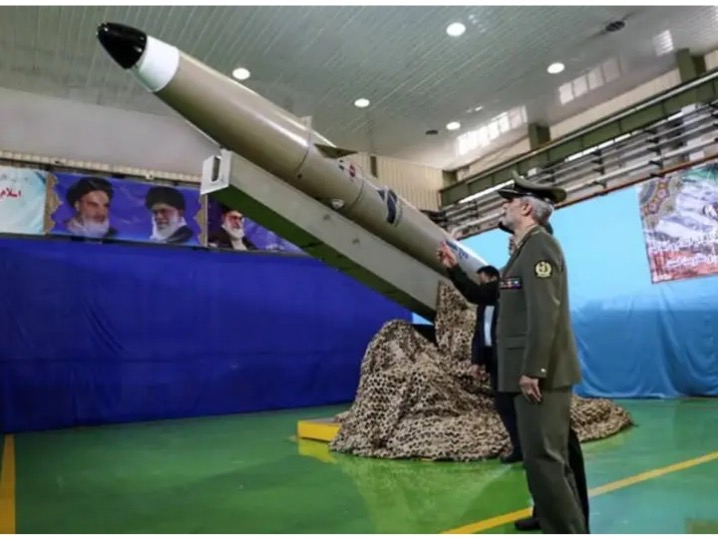
“Khorramshahr-4”: Deterrence through Precision and Terror
The Event: The unveiling of the new missile (1,500 kg warhead, 30-meter accuracy) from inside a new “Missile City.”
The Dual Message:
Timing: The announcement came immediately upon Witkoff’s arrival. Iran is saying: “We do not negotiate from weakness. We possess missiles capable of destroying your bases with surgical precision.”
Specifications: A warhead of this weight (1.5 tons) is capable of destroying fortified bunkers and command centers, and an accuracy of 30 meters implies it is an operational weapon, not a random one. This is a direct response to threats of “destroying nuclear facilities.”
The Missile City: Unveiling this facility negates previous rumors of “fear and cancellation” and confirms that the IRGC possesses underground infrastructure that is difficult to destroy via conventional airstrikes.
Return of the “Shadow General”: Shamkhani as Secretary of Defense
The Event: The appointment of Admiral Ali Shamkhani as Secretary of the Supreme Defense Council.
The Analysis:
Shamkhani is the architect of hard security strategies. His return to this sensitive post indicates that the state is moving toward the “militarization of political decision-making.”
This appointment reassures the Revolutionary Guard and signals to both domestic and foreign audiences: “The defense file is in the hands of hawkish professionals, not just diplomats.”
NOTAM Status (Evening Update):
NOTAM [B0101/26] – (Kish 2):
Status: Active and Confirmed (Expires Feb 7). The southern Gulf region is militarily closed. This NOTAM is the “live field” supporting Iran’s negotiating position in Muscat.
NOTAM [A0065/26] – (West Iran):
Status: Active. Security of western airspace continues.
NOTAM [A0423/26] – (City Celebrations):
Status: Scheduled (Feb 10). The insistence on scheduling “fireworks” over all cities next week is a psychological challenge and a message of confidence that the regime remains permanent and stable despite threats.
Conclusion and Assessment:
The current scene is a “game of chess played with fire”:
In Muscat: Witkoff is attempting to impose American conditions.
In Tehran: Shamkhani holds the defense file, and “Khorramshahr” missiles are emerging from their silos.
In the Gulf: NOTAM (B0101) is besieging the sea.
The Result:
Iran is telling Witkoff: “Look at our missiles and our closure of the Gulf before you dictate your terms.” The coming hours in Muscat will determine whether these missiles remain tools of deterrence or are launched toward their targets. Witkoff’s arrival has temporarily frozen the “war clock,” but the Khorramshahr missiles have kept the finger on the trigger.