


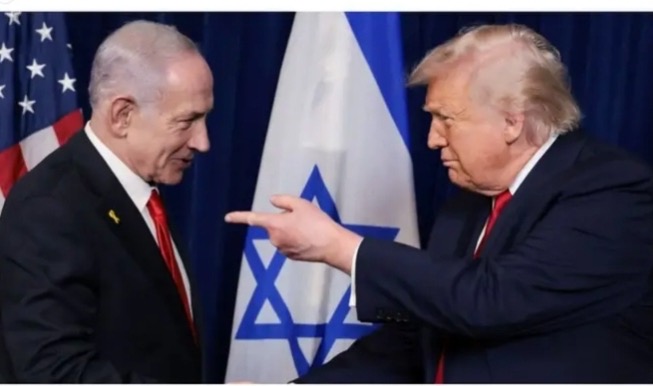
Benjamin Netanyahu has landed in Washington on a mission that Israeli commentators are no longer disguising: to push the United States into war.
This is not speculation from foreign critics. It is the sober assessment of Israel’s own senior journalists, intelligence sources, and former officials. Netanyahu’s hasty trip—moved forward on an unusual schedule—signals urgency bordering on panic. Time is not on his side. Diplomacy is moving faster than his war window.
Nahum Barnea draws a brutal historical parallel. In 1973, Golda Meir flew to Washington terrified that the United States would cut a deal behind Israel’s back. She was right. America dictated the postwar reality, blocked Israel’s total military victory, and forced a strategic outcome Israel did not control. What felt like humiliation later became the Egypt–Israel peace treaty. Bitter at the time. Sweet in retrospect.
Netanyahu is now replaying that moment—but with far less leverage.
The enemy, as Barnea notes, is no longer Kissinger. It is Trump’s inner circle and Trump himself. Netanyahu is not trying to shape policy; he is trying to override Trump’s instincts, his political base, his regional partners, and his stated preference for deal-making over endless war. Flattery alone will not work this time.
Netanyahu is offering Trump a gamble: sell another war as short, decisive, glorious, and politically profitable—especially with U.S. midterm elections looming. Iran, he insists, will fold like Venezuela. The regime is allegedly weak. The strike will be fast. The benefits will outweigh the costs.
What is downplayed—deliberately—is the price already paid. Israeli lives lost. Bodies broken. Property destroyed. Scientific infrastructure damaged. The last “brilliant” operation was so intoxicating that it erased the memory of its consequences. Netanyahu now asks Trump to believe the next one will be cleaner, faster, and final.
Israeli sources admit the bet is twofold: failure humiliates Netanyahu; success traps Trump in a war with no exit.
Behind closed doors, Netanyahu’s demands are no longer vague. According to Ma’ariv, this visit is about concrete conditions. Israel flatly rejects any agreement with Iran that focuses only on nuclear limits. Monitoring must be airtight. Timelines rigid. Restrictions irreversible. Partial deals are unacceptable because they allow Iran to recover economically while retaining strategic leverage.
_____
What terrifies Jerusalem is not Iranian diplomacy—it is American flexibility.
The signals from Washington are deeply unsettling to Israel’s political class. Trump appears willing to explore a focused nuclear agreement, even if it postpones other issues. Israel fears waking up to a fait accompli: sanctions relief, economic recovery for Iran, and a regional balance that shifts against Israeli dominance.
This is why the “Wing of Zion” took off. This is why every other issue was shoved aside. This is Netanyahu’s last attempt to tip the scales before decisions harden in Washington.
Yet Israel itself admits a critical contradiction. According to Israeli security officials, Iran is no longer a nuclear threshold state after last June’s strikes. The real threat now is ballistic missiles. Thousands of them. Precision-guided. Long-range. A capability that makes nuclear warheads unnecessary.
This admission blows apart years of narrative discipline. Nuclear weapons are no longer the core danger; missiles are. And missiles are precisely what Iran refuses to give up—because surrendering them would mean strategic suicide.
Even Netanyahu concedes uncertainty. Despite unprecedented Israeli–American coordination, he told lawmakers plainly: “I don’t know what Trump plans to do in the end.”
Israel is preparing anyway. Hezbollah is the contingency. Israeli military sources openly frame the next war as existential—not just for Israel, but for Hezbollah itself. If Iran falls, Hezbollah collapses. That reality makes restraint unlikely. A wider war is not a risk—it is an expectation.
Strip away the talking points and what remains is stark: Netanyahu is racing diplomacy, history, and domestic collapse. He is trying to lock America into a war before negotiations close the door. Not because war is inevitable—but because peace would end his leverage.
This is not strategic confidence.
It is strategic desperation.
And Washington knows it.