


By Kio Amachree
Every few years the same question resurfaces: Who was Nigeria’s best leader since independence?
It is a comforting question. It implies that somewhere in our post-colonial history lies a golden period, a near-miss, a leader who “almost got it right.”
I do not share that view.
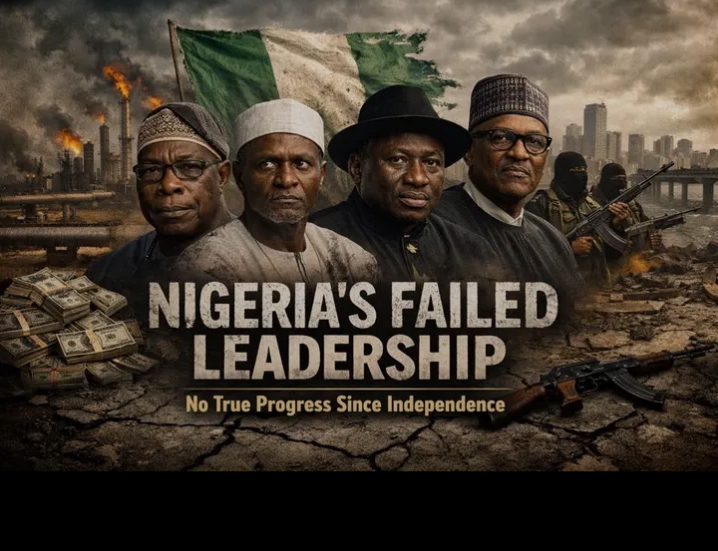
The more honest question is this: why has Nigeria failed to produce a single post-independence leader who fundamentally transformed the lives of its citizens?
What follows is not a ranking, nor an endorsement. It is a sober examination of the names most often cited — and why, despite their reputations, none meets the standard of truly effective national leadership.
Olusegun Obasanjo: The Least Bad Is Not the Best
Obasanjo is frequently presented by analysts as Nigeria’s “best” leader, largely by comparison rather than achievement.
Yes, Nigeria exited military rule under his watch.
Yes, an estimated $18 billion in external debt was written off.
Yes, telecom liberalization expanded access.
But these are administrative corrections, not national transformation.
Under Obasanjo:
• Corruption became institutional rather than episodic.
• Power generation remained stagnant despite oil revenues.
• Infrastructure decayed while patronage politics flourished.
• An attempted third-term power grab exposed the fragility of Nigeria’s constitutional culture.
Calling this success sets the bar dangerously low.
Umaru Musa Yar’Adua: Good Intentions Are Not Governance
Yar’Adua is often remembered fondly for his humility and respect for due process. That reputation is not undeserved.
But leadership is measured in outcomes, not temperament.
His presidency was:
• Largely absent due to prolonged illness.
• Administratively paralysed.
• Defined more by what might have been than what was delivered.
Nigeria does not suffer from a shortage of good intentions. It suffers from a shortage of execution.
Goodluck Jonathan: Democratic Symbolism, Strategic Failure
Jonathan’s peaceful concession of electoral defeat was historic and deserves recognition.
But symbolism cannot substitute for governance.
His tenure coincided with:
• Billions of dollars in alleged oil revenue leakages, publicly flagged by the Central Bank.
• The unchecked expansion of Boko Haram.
• A political culture that confused tolerance with weakness.
Nigeria became Africa’s largest economy on paper — while poverty, insecurity, and institutional decay deepened beneath the surface.
Muhammadu Buhari: Anti-Corruption as Performance
Buhari arrived with enormous moral capital and a promise to reset Nigeria.
What followed was:
• Selective anti-corruption enforcement.
• Worsening poverty indicators.
• Currency instability.
• Expanding insecurity across multiple regions.
By the end of his tenure, Nigeria was poorer, more insecure, and more polarised than when he began.
Rhetoric replaced reform.
The Deeper Problem: A Leadership Class, Not Individual Failures
Nigeria’s tragedy is not that it chose the wrong leaders.
It is that the system reliably produces the same type of leader:
• Power without accountability.
• Wealth without productivity.
• Authority without service.
• Politics as personal enrichment, not national stewardship.
Measured against global standards — not African excuses — Nigeria has not had a great leader since independence. It has had caretakers, survivors, tacticians, and opportunists.
Conclusion: Stop Ranking Failure
Asking who Nigeria’s best leader was since 1960 risks normalising underperformance.
It trains citizens to choose between bad options rather than demand excellence.
Nigeria does not need another “least terrible” president.
It needs leaders who:
• Build institutions that outlive them.
• Treat public money as sacred.
• Deliver security, power, infrastructure, and justice — not excuses.
Until then, the honest answer to the question remains uncomfortable but necessary:
There has been no truly good Nigerian leader since independence.