


By Kunle Oshobi
The year is 2024, and Nigeria finds itself at a familiar crossroads. The economy staggers under the weight of inflation that has turned the naira into something resembling Monopoly money. Small businesses shutter their doors like dominoes. Young graduates hawk bottled water in Lagos traffic, their degrees gathering dust in rented rooms. And in the midst of this economic tempest, the federal government has decided that what Nigeria truly needs is a $11 billion coastal road from Lagos to Calabar.
Let that sink in for a moment. Eleven billion dollars. In a country where the minimum wage struggles to buy a bag of rice.
The Tale of Two Visions
Picture two men standing at the edge of a drought-stricken farm. The first man points to the distant horizon and declares, “We shall build a magnificent highway across this land!” The second man kneels, touches the parched soil, and says, “We shall dig wells and give every farmer the tools to make this land bloom again.”
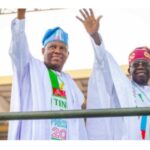
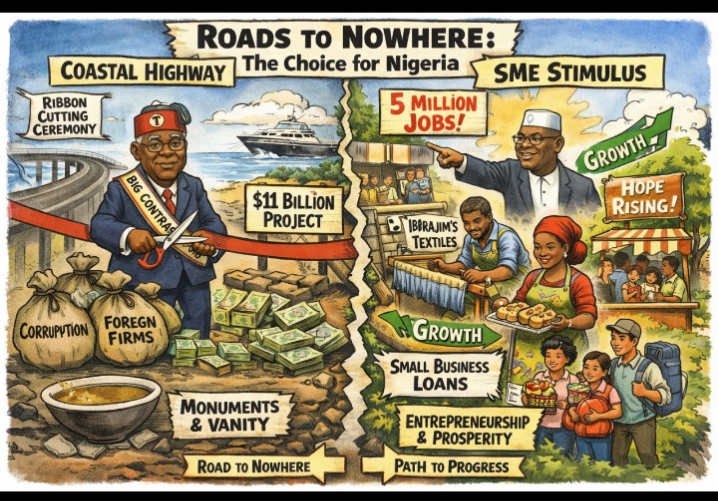
This is essentially the choice before Nigeria today: Tinubu’s coastal highway versus Atiku’s proposed economic stimulus plan. One is a monument. The other is a movement.
The coastal road project, awarded without competitive bidding to a company with convenient connections to the presidency, promises to transform travel along Nigeria’s southern coast. It will be impressive, no doubt. Engineers will marvel at it. Ribbon-cutting ceremonies will make for excellent photo opportunities. Years from now, government officials will point to it as evidence of visionary leadership.
But monuments don’t put food on tables. They don’t create the kind of widespread economic transformation that Nigeria desperately needs.
The Mathematics of Hope
Now consider Atiku’s alternative: a $10 billion economic stimulus package designed to provide concessionary loans to small and medium enterprises. The numbers tell a story that should make every Nigerian sit up and pay attention.
Ten billion dollars converts to approximately 15 trillion naira. Distributed as loans averaging three million naira to five million entrepreneurs, this package would create ripples across the entire economic landscape. Not ripples, actually—tidal waves.
Imagine Chioma in Aba, who makes the most exquisite leather shoes but can’t afford to scale up production. With a three million naira loan at concessionary rates, she could buy better equipment, hire three more artisans, and fulfill orders from boutiques in Lagos and Abuja. Her business becomes a job creator, not just for herself, but for her community.
Think of Ibrahim in Kano, whose small textile business is suffocating under the weight of expensive commercial bank loans. A three million naira injection at favorable terms means he can import better dyeing equipment, employ more workers, and compete with the imported fabrics flooding Nigerian markets. His workers, now earning steady incomes, spend money at the local market, the children’s school, the neighborhood pharmacy. The economic multiplication effect is instantaneous.
Consider Ngozi in Port Harcourt, whose catering business has the potential to become a major player in the events industry but lacks the capital to purchase essential equipment and market properly. With access to affordable financing, her business employs more cooks, drivers, and support staff. Each of these employees becomes a consumer, spending money that circulates through the economy like blood through a healthy body.
The Corruption Question
But let us address the elephant doing backflips in the room: the corruption allegations surrounding the coastal highway project.
When a project worth $11 billion is awarded without competitive bidding, alarm bells don’t just ring—they scream. When that contract goes to a company owned by the president’s close business associate, those alarm bells start playing funeral dirges. Due process isn’t just bureaucratic red tape; it’s the mechanism that ensures public funds serve public interest, not private pockets.
The irony is almost poetic. A government that came to power promising to fight corruption has essentially erected a billboard advertising the opposite. The coastal highway project doesn’t just represent misplaced priorities—it represents the kind of brazen impunity that has kept Nigeria perpetually on the edge of its potential.
Contrast this with a well-structured SME stimulus package. The decentralized nature of such a program, with loans going to millions of businesses across the country, makes large-scale corruption significantly more difficult. Yes, there will be challenges with implementation. Yes, some loans will default. But the very structure of the program makes it self-policing in ways that
massive infrastructure contracts can never be.
Infrastructure or Transformation?
The predictable counter-argument goes like this: “But Nigeria needs infrastructure! How can you be against development?”
This is a false choice wrapped in a red herring and served with a side of misdirection.
Nobody is against infrastructure. Roads, bridges, and railways are essential for economic development. But in a country where businesses are collapsing from lack of capital, where unemployment is creating a generation of desperate young people, where the productive capacity of the economy is grinding to a halt—building a coastal highway is like buying a sports car when you can’t afford food.
Priority matters. Timing matters. And right now, Nigeria’s priority should be rescuing its productive sector from collapse.
The coastal highway will employ construction workers—mostly foreign contractors and their imported labor. When completed, it will marginally improve travel times for those who can afford vehicles and fuel. These are not negligible benefits, but they pale in comparison to what five million thriving businesses could do for Nigeria.
Those five million businesses would employ tens of millions of Nigerians. They would generate tax revenue that dwarfs what the coastal highway could ever produce. They would reduce import dependence by producing goods locally. They would train workers in marketable skills. They would create wealth that circulates within Nigerian communities rather than flowing into foreign contractors’ accounts.
The Multiplier Effect
Economic stimulus packages work because of something economists call the multiplier effect. When you give a small business owner capital, they don’t just sit on it. They use it to buy equipment, hire workers, purchase raw materials, and expand operations. Each of these transactions creates additional economic activity.
The worker hired by the business uses their salary to pay rent, buy food, and send their children to school. The landlord uses the rent to maintain the property and pay their own bills. The food seller uses their earnings to restock inventory. The school uses the fees to employ teachers and improve facilities. And on and on the cycle goes, each transaction generating economic activity that creates jobs, generates tax revenue, and improves living standards.
A coastal highway, magnificent as it may be, cannot replicate this multiplier effect. It’s a one-time boost to the construction sector, then a finished product that sits there looking impressive while the economy around it continues to struggle.
The Verdict of History
Future historians will look back at this moment and ask: What was Nigeria’s leadership thinking? In the midst of economic crisis, why did they choose monuments over movements? Why did they prioritize photo opportunities over productive capacity?
The answer, sadly, is likely to be found in the usual culprits: vanity, corruption, and a fundamental misunderstanding of what drives economic transformation.
Nigeria doesn’t need more impressive infrastructure that primarily serves the wealthy and well-connected. It needs a thriving ecosystem of businesses creating jobs and generating wealth. It needs entrepreneurs who are empowered rather than suffocated. It needs an economy that works for the many, not the few.
Atiku’s stimulus plan isn’t perfect. No policy ever is. But it represents a fundamentally different approach to governance—one that recognizes that Nigeria’s strength lies in the creativity, resilience, and entrepreneurial spirit of its people. Give them the tools they need, and they will build an economy far more impressive than any coastal highway.
The choice is clear. The question is whether Nigeria’s leaders have the wisdom to make it, or whether they’re too busy planning their next ribbon-cutting ceremony to notice the economy burning around them.
– Kunle Oshobi, Head of Strategy and Planning of the Narrative Force writes from Lagos.