


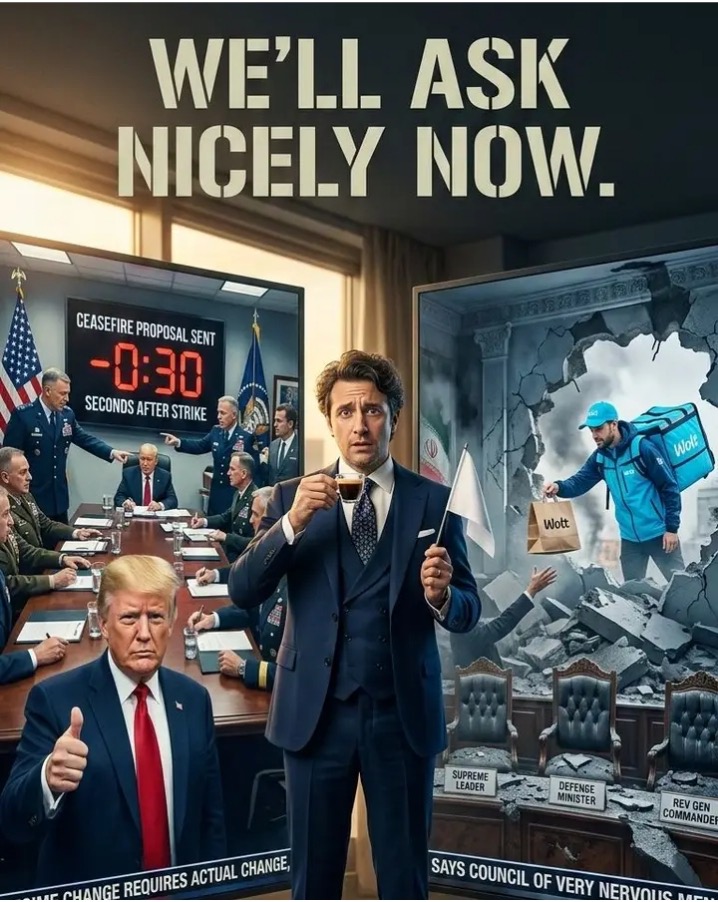
Or: How Trump Learned to Stop Worrying and Love the Ceasefire He Just Rejected
In a stunning display of military planning that can only be described as “aggressive diplomacy with an ejection seat,” the United States has reportedly asked Iran for a ceasefire approximately thirty seconds after assassinating its entire leadership. The proposal, delivered through an Italian mediator who presumably asked “are you absolutely sure about the timing here?” was, predictably, rejected outright by a regime currently trying to figure out who’s even left to answer the phone.
Let us appreciate the strategic genius at work here. American officials initially envisioned a “four- to five-day operation” that would bring a weakened Tehran to the negotiating table. Instead, on “the eve of the strike,” they apparently thought: “You know what? Let’s skip the whole weakening part and just ask nicely right now.” It’s the diplomatic equivalent of punching someone in the face and immediately offering them a hug, then being shocked when they’re not in the mood.
Supreme Leader Ali Khamenei is dead. So are Iran’s defense minister, chief of staff, and the commander of the Revolutionary Guard. It is, by all accounts, an “extraordinary intelligence and operational achievement” that would make the Six-Day War look like a minor scuffle. And yet, somehow, the ayatollahs’ regime has not collapsed. It turns out regimes, much like cockroaches and certain reality television stars, are remarkably good at surviving decapitation.
The regime is currently being run by “a council of senior officials,” which is diplomatic language for “a bunch of guys who are definitely sleeping with one eye open and reconsidering their career choices.” The summary of Operation Rising Lion (yes, they named it that) showed that the Iranian regime “knows how to survive the loss of its top figures.” Translation: the survival of the regime matters more than the survival of literally anyone in it.
Trump, we are told, can end this operation in three ways that can be marketed as success. One: a severe military blow that weakens the regime. Two: a surrender agreement on the nuclear issue. Three: the fall of the regime. The first is “realistic,” the second “less so,” and the third is “Trump’s great hope and his major gamble.” In other words: we have a plan, a slightly less plausible plan, and a plan that requires the Iranian people to do what American soldiers won’t.
Because here’s the thing about regime change that seems to escape every White House since the Bush administration: you cannot impose it from 30,000 feet. “Trump does not intend to dispatch troops into the streets of Tehran,” the article notes, which is diplomatic for “he saw the Iraq War footage and decided Door Number Three sounds much better.” His version of boots on the ground is “the millions of Iranians who are fed up with the Islamic Republic.” On Saturday, he urged them to stay home. Later, he may call on them to go out. Nothing says leadership like “stay inside while I bomb your government, but maybe protest later if it’s convenient.”
From an American perspective, we are reminded, “this is a war of choice.” Iran did not pose a direct threat to the United States. Even its nuclear project does not necessarily constitute grounds for war—Trump has, after all, “come to terms with North Korea’s nuclear weapons, let alone those of India and Pakistan.” The Iranian regime “slaughters its own citizens, funds terrorism and amasses a dangerous arsenal, but these are not matters that weigh heavily on Trump.” Refreshing honesty, that. The attack is, apparently, his way of declaring: “I am MAGA, I restored America’s greatness.” Nothing says greatness like a war of choice that’s already unpopular with both his critics and his staunch supporters.
Meanwhile, an Israeli businessman offers perhaps the most telling detail of the entire operation: “War or no war, Wolt delivery couriers continued as usual. Perhaps more than usual. Young riders with blue backpacks took over the streets, turning the war with Iran into something almost routine, with lunch delivered to their safe room doorstep.” There it is—the ultimate victory condition. The missiles may fly, the leaders may fall, the regime may or may not collapse, but as long as someone brings lunch, civilization continues.
Trump, we are told, considers himself smarter than both Bushes—the one who stopped at Kuwait and the one who didn’t stop until Baghdad. He is “convinced he is smarter than both.” History, as always, will render its verdict. But for now, the quickest exit in the West remains elusive, the Italians are very confused about their role in all this, and somewhere in Tehran, a council of very nervous men is trying to figure out how to run a country when the instruction manual was just eliminated.
The delivery couriers, at least, are working overtime.
#WarOfChoice