


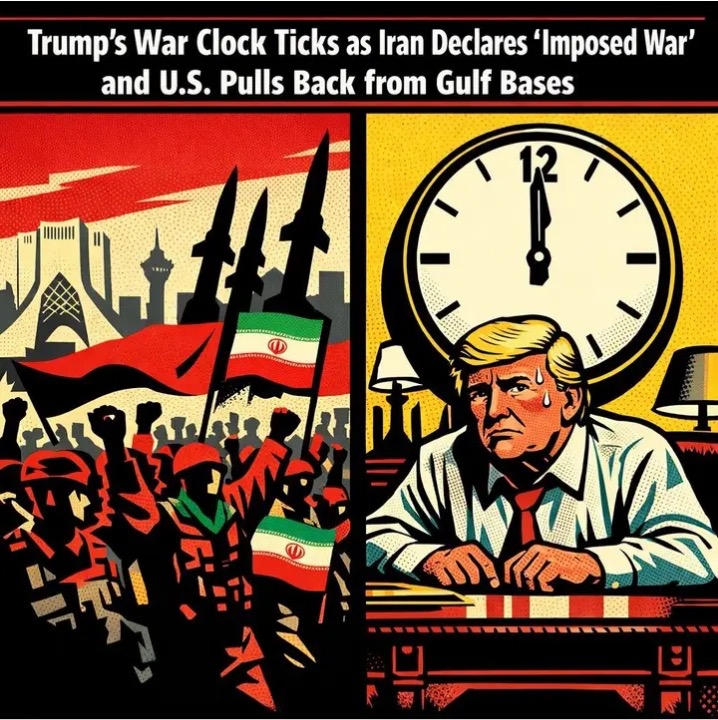
2 March 2026 — The strategic clock is now ticking on multiple fronts as Iran shifts to full wartime mobilisation and the Pentagon quietly begins repositioning forces across the Gulf, while U.S. Defence Secretary Pete Hegseth has reportedly set a five-week timeline for “victory” in a high-stakes briefing that underscores the growing pressure on Washington to deliver rapid results.
Tehran’s declaration of an “imposed war” and its order for all ministries to operate under emergency wartime authority marks a decisive transition from calibrated retaliation to long-term national mobilisation. The move allows the Iranian state to redirect economic output, media messaging, logistics and internal security toward sustaining a protracted conflict — a posture designed to signal endurance rather than escalation for its own sake.
At the same time, the United States has begun what officials describe as precautionary posture changes.
Hundreds of troops and non-essential personnel have been withdrawn from Al Udeid Air Base in Qatar, while key aircraft — including refuelling tankers and surveillance platforms — have been dispersed. In Bahrain, vessels linked to the U.S. Fifth Fleet have moved out of port to positions further from Iran’s coastal missile range. In Kuwait and the UAE, forces remain in country but have shifted into hardened shelters amid embassy warnings of possible attacks.
The repositioning comes as casualty figures become a central battleground in the information war.
Iran’s Islamic Revolutionary Guard Corps claims its strikes have left more than 560 U.S. troops killed or wounded, a number that has not been independently verified. U.S. Central Command has confirmed four American service members killed in action, along with additional wounded — the first officially acknowledged combat deaths of the campaign.
The gap between the two accounts reflects the wider struggle to control public perception as much as events on the ground.
Against this backdrop, Hegseth’s reported five-week victory timeline, delivered during a Pentagon briefing on Monday, introduces a stark contrast in war aims. While Washington appears to be working to a compressed operational window, Iran is openly preparing its population and institutions for a drawn-out confrontation.
For President Donald Trump, the military question is increasingly tied to political time. A rapid, decisive outcome would validate the strategy. A longer war — exactly the scenario Tehran is signalling — risks testing U.S. domestic support, alliance cohesion and the resilience of regional force deployments.
The battlefield may stretch across the Gulf, but the decisive factor could be which side’s clock runs out first.