


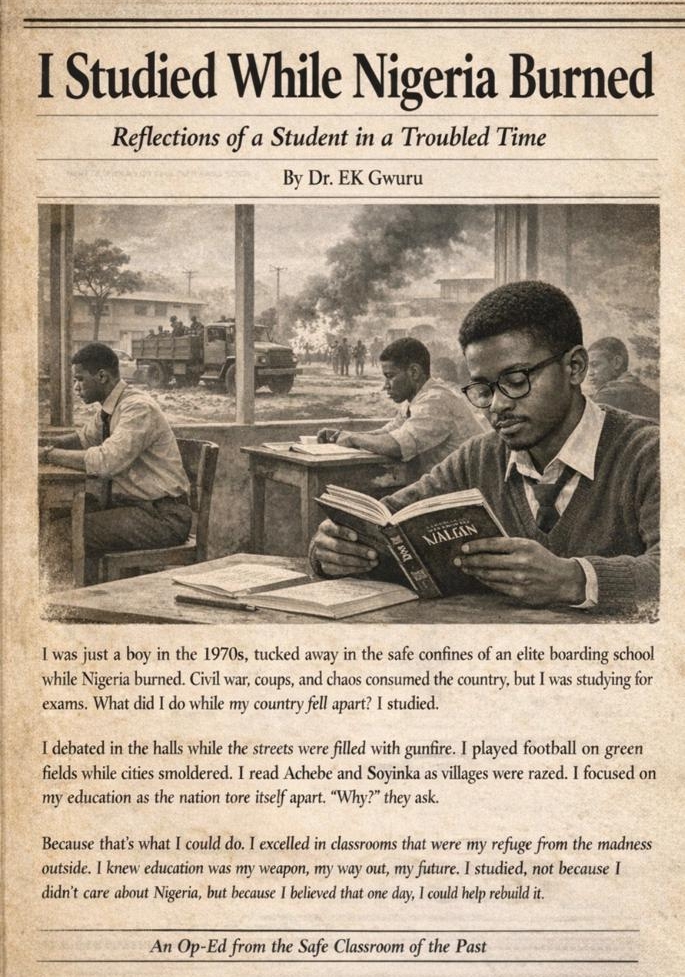
By EK Gwuru
For decades, Nigeria invested heavily in a generation it believed would save her.
From the 1970s through the early 1980s, the nation built elite secondary schools, funded scholarships, recruited the finest teachers, and sheltered thousands of young Nigerians from the turbulence of coups, oil shocks, and political decay. We were trained in discipline, logic, debate, and civic duty. We read Plato and Achebe, Shakespeare and Soyinka. We were told, explicitly and implicitly, that we were being prepared to lead.
We were the chosen.
And yet, half a century later, Nigeria is governed not by the best of that generation, but by the loudest, the crudest, and the most shameless.
Something went terribly wrong.
The Paradox of Privilege
We must begin with an uncomfortable truth: elite education did not fail because it was inadequate. It failed because it was never matched with moral courage.
We were taught how to think.
We were not taught how to resist.
We were trained to excel.
We were not trained to confront power.
We mastered examinations.
We avoided responsibility.
While dictators looted, we calculated exchange rates.
While institutions collapsed, we wrote foreign applications.
While public life degraded, we perfected private comfort.
We became brilliant spectators to our own national decline.
The Rise of the Unprepared
Nature abhors a vacuum. So does politics.
When educated citizens retreat from public life, others rush in.
Into the space vacated by thoughtful leadership came political opportunists, ethnic merchants, religious hustlers, and career agitators. Men with no ideas, no preparation, and no long-term vision learned how to manipulate anger, poverty, and identity.
They did not defeat the educated class.
They replaced it.
Not through merit, but through audacity.
Not through vision, but through noise.
Not through service, but through survival instincts.
Today, Nigeria is governed largely by people who mistake cunning for intelligence and theatrics for leadership.
And we, the educated, allowed it.
The Great Escape
Our generation mastered one skill better than any other; escape.
We escaped into foreign universities.
We escaped into multinational corporations.
We escaped into consultancies and NGOs.
We escaped into silence.
We called it “being realistic.”
We said politics was dirty.
We said the system was broken.
We said nothing could change.
So we built personal success on collective failure.
We became comfortable in collapsing houses.
Education Without Ethics
The tragedy is not that we were educated.
The tragedy is that our education was hollow.
It produced competence without conscience.
Degrees without duty.
Intelligence without integrity.
We learned how to win.
We never learned why winning mattered.
We learned how to compete.
We never learned how to serve.
We learned how to rise.
We never learned how to lift.
A society cannot survive on brilliance alone. It survives on character.
Nigeria invested in brains.
It neglected backbone.
The Silence of the Informed
Perhaps the greatest crime of the educated elite is not corruption.
It is silence.
When elections were rigged, we rationalised.
When courts were compromised, we adjusted.
When truth was assaulted, we shrugged.
We became experts at “managing reality.”
We learned to live with dysfunction.
We learned to normalise disgrace.
We learned to survive in decay.
And survival replaced citizenship.
Why Did We Surrender the State?
Because governing a broken system is harder than benefiting from it.
Because reform requires sacrifice.
Because courage has a cost.
Because it is easier to complain than to contend.
Because many of us preferred moral purity in private to moral struggle in public.
So we ceded the arena.
And others took it.
A Generation’s Reckoning
This is not an attack on education.
It is a warning about what education becomes without responsibility.
A society that trains its brightest to flee, conform, or compromise will eventually be ruled by its least prepared.
Nigeria is living proof.
We cannot blame the “urchins” who occupy power today without first interrogating the silence of those who abandoned it yesterday.
They came because we left.
The Unfinished Assignment
Our education was not meant to be an exit visa.
It was meant to be a social contract.
We were trained at public expense, financially and morally, to build a nation, not merely to survive one.
That assignment remains unfinished.
And time is running out.
If the educated class does not re-enter public life with courage, humility, and long-term vision, Nigeria will continue drifting—rich in talent, poor in leadership.
A Final Question
History will not ask how many degrees we earned.
It will ask what we did with them.
When Nigeria was bleeding,
did we bandage her,
or did we look away?
When institutions collapsed,
did we rebuild,
or did we relocate?
When mediocrity rose,
did we resist,
or did we retreat?
We studied while Nigeria burned.
But studying was never enough.
Leadership was always the exam.
And for too long,
we refused to sit.
– Dr. EK Gwuru, writer, social analyst, and creative strategist based in Nkolo Ikembe. Explores the intersections of culture, governance, and human progress across Africa and the diaspora.