


By Adeyemi Ridwan Adewale
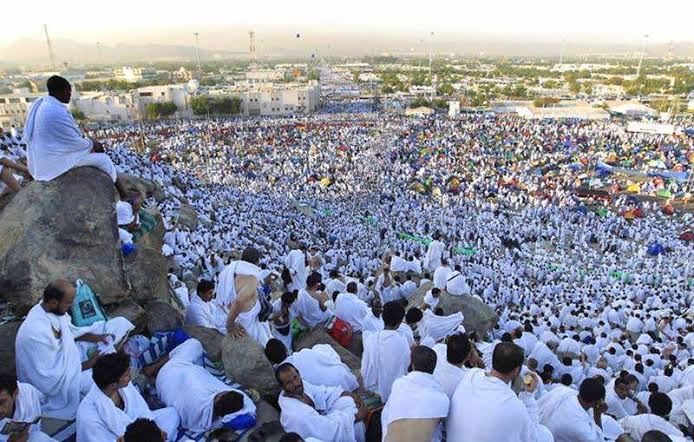
On the ninth day of Dhul Hijjah, the sun rises on a scene that defies earthly logic. In a plain of scorched granite and dust, surrounded by bare mountains, over two million human beings stand shoulder to shoulder. They wear not silk or gold, but two seamless white sheets. Kings, Emirs and Janitors, Billionaires, Trillionaires and Beggars, Black and White, Arab and Latin, the distinctions of a lifetime dissolve into a single, pulsing mass of humanity.
This is Arafah
To the outside observer, it is simply a gathering in the desert. To the believer, it is the closest the material world comes to the Day of Judgment. But beyond theology, beyond ritual, the Day of Arafah holds a significance that ripples through the entire human race, whether conscious of it or not.
The Grand Rehearsal of Equality
Long before modern declarations of human rights, the Prophet Muhammad stood on the Mount of Mercy at Arafah and delivered a sermon that cracked the foundations of social hierarchy. “No Arab is superior to a non-Arab, nor white to a black, except by piety.”
On this day, that ideal becomes a physical reality. The Ihram (those two unstitched white sheets) is the great eraser. It strips away titles, nationalities and wealth. It is a living, breathing manifesto that every human being enters the world the same way (naked and crying) and will leave it the same way (wrapped in simple cloth). In an age obsessed with branding and status, Arafah performs a radical, silent revolution: for a few hours, no one is better than anyone else and this is not a utopian dream. It is a yearly appointment with truth.
The Day Mercy Overwhelms Justice
There is a famous hadith in which the Prophet Muhammad says: “There is no day on which Allah frees more people from the Fire than the Day of Arafah.”
Yes, let that sink in. Not Ramadan. Not the night of power. But Arafah.
In a world where we are taught that every mistake carries a permanent price tag, Arafah announces a different law, the law of overflowing mercy. It is the day when God draws near to His creation, like a parent leaning in to hear a whisper, and asks the angels, “What do these people want?”
The answer is staggering. They want to be forgiven. Not for small slips, but for the wreckage of a lifetime: betrayals, addictions, abandoned prayers, broken hearts they caused. And according to Islamic tradition, on this day, the gates of forgiveness swing open for all who ask, except the sins we have committed against other people, which require a different reconciliation process.
This is where Arafah speaks to the human soul directly. Deep down, every person carries a weight, a secret shame, a regret that rises in the quiet hours of 3AM. Arafah is the divine permission slip to put it down.
The Unspoken Cry for Oneness
On this day, Muslims are not just praying for themselves. The Prophet taught that the pilgrims’ supplication on Arafah is the “best of all supplications,” and it is almost always in the plural: Forgive us. Have mercy on us. Guide us.
At the exact moment the sun reaches its zenith over that desert plain, millions of Muslims around the world who are not on pilgrimage will fast this day. And they will raise their hands for an entire global community, for the starving child, for the oppressed prisoner, for the confused teenager, for the woman whose faith is hanging by a thread.
The Day of Arafah turns monotheism into a collective act. It shatters the myth of the “lone spiritual seeker.” On this day, no one is saved alone.
A Message to the Non-Believing World
Even if you never step onto that plain, even if you never fast, the Day of Arafah offers something to the whole human race: A Mirror.
Consider what happens there. Two million people, united in humility, admitting their brokenness, asking for a fresh start. It is the largest annual therapy session on the planet. It is a global ceasefire of the ego.
In a world torn by tribalism and insecurity, Arafah models radical unity without uniformity. No one loses their identity, the Indonesian keeps his culture, the Nigerian keeps hers, but they melt into a chorus of Labbayk (Here I am, at Your service). It is the antidote to the loneliness of modern life. It is the anti-social media, instead of performing a curated self, you surrender your constructed self entirely.
Finally, The Electrifying Detail
Why is this day so powerful? The Qur’an reveals a secret: On the Day of Arafah, the verse of Completion was revealed:
“Today I have perfected your religion for you, completed My favor upon you and have chosen for you Islam as your religion.” (Quran 5:3). Perfection. Completion and finality.
That means the day of Arafah is not just a day in history. It is the day that sealed sacred history. Every prophet, every struggle, every scroll, it all culminated in this moment of standing, weeping, and asking. It is as if the entire river of revelation poured into the plain of Arafah and said, “Now, drink.”
Your Personal Arafah
You may never see that desert. But you can make this day your own appointment with the Divine. Choose the Day of Arafah as your day of supplication, not a quick list of requests, but a pouring out of your entire mind, your unspoken fears, your buried hopes, your quiet shames.
Fast, yes. But more than that, before the sun sinks low, find a corner of solitude. As the shadows lengthen toward sunset, that sacred, aching moment when the pilgrims on the plain are raising their hands with tears streaming down their faces, you too can raise yours.
Let every worry, every guilt, every secret hope spill from your lips. Forgive someone who doesn’t deserve it. Call a relative you have cut off. Sit alone and say, sincerely, for the first time in years “I am not what I have done. I am what I am about to ask for” Because the Day of Arafah whispers a truth that makes the mountains tremble: mercy is not something you earn. Mercy is something you walk into.
And in those final, golden moments before sunset, when the gates of heaven are said to be at their widest, walk in with your whole, honest, messy heart.
Today, the door is wider than the horizon. Walk through it and make the most out of this day.
And for those nearby, know that Al-Habibiyyah is organising a special prayer on the Day of Arafah between 4:30pm and Maghrib at the Al-Habibiyyah Islamic Center, Guzape, Abuja; a perfect opportunity to gather, raise hands together and catch that blessed wave of mercy before the sun bids farewell.
Adeyemi Ridwan Adewale is a writer and an Islamic tutor at Al-Habibiyyah Islamic Centre, Guzape Abuja.