


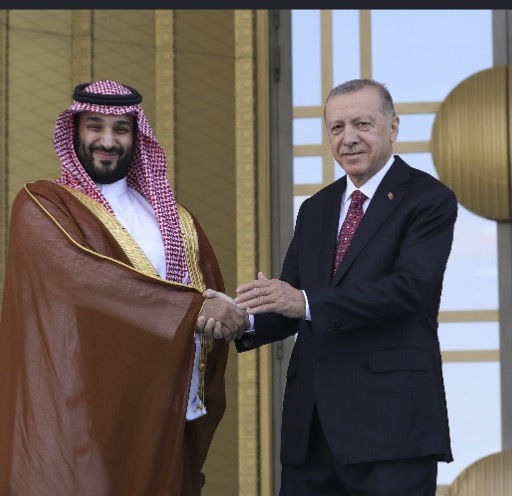
Turkey and Saudi Arabia signed landmark agreements on June 9th to revive the Hejaz Railway, a historic Ottoman-era line that once connected Istanbul to Medina.
The revived project envisions a corridor running from Bulgaria through Istanbul, Damascus, Amman, and the Saudi holy cities, eventually reaching Sohar in Oman at the entrance to the Strait of Hormuz. It is one of the most ambitious infrastructure projects the Middle East has seen in decades.
Israel has asked Trump to block it.
Netanyahu’s right-wing coalition members have moved to send at least 11 emails to US Republican lawmakers, arguing that the project violates the spirit of the Abraham Accords and represents a hostile geopolitical realignment.
Israel’s argument is straightforward: if the Sunni nations the railway passes through form a strong alliance, the strategic value of Israel’s Haifa port would decline, and the India-Middle East-Europe Economic Corridor that positions Israel as a central transit hub connecting the Gulf to Europe would be undermined.
Translation: a railway that connects the Muslim world from Europe to the Arabian Sea, bypassing Israel entirely, is an existential economic threat to Tel Aviv’s regional ambitions.
Turkish Trade Minister Omer Bolat was admirably candid about the project’s intent: “The reduction of Israel’s influence in the region, together with increased political and economic solidarity among us, will bring economic prosperity, peace and stability to the Middle East.” He said the quiet part out loud. Israel heard it clearly.
The timing is the story. The US-Israel-Iran war disrupted one of the Gulf’s most important trade routes, the Strait of Hormuz, and prompted countries to seek alternative transport corridors.
Every week the strait was closed, the argument for overland alternatives grew stronger. Every tanker that could not move through Hormuz was a tanker that needed another route. The Hejaz Railway is the Middle East’s answer to a vulnerability the Iran war exposed with brutal clarity.
We are at the thresholds of a new Middle East with diminished influence of the US and Israel, and the Saudi-Turkey railway project is economically much more viable and strategically more doable after the Iran war, one analyst told Al Jazeera.
The deeper significance extends beyond trade. The revival of the Hejaz Railway signals a new possibility for the Middle East amidst a crumbling order. The fading security architecture with the US at the centre and Israel as its colonial presence has brought neither peace nor security to the region.
Israel recognises what it is looking at. A railway is not just infrastructure. It is an alliance made physical, a corridor of political solidarity rendered in steel and concrete, connecting Muslim capitals from the Bosphorus to the Arabian Sea without passing through a single kilometre of Israeli-controlled territory.
Turkey would have a strategic economic presence next to Israel’s Eilat, which is its only direct route to the Red Sea. That is not a trade dispute. That is encirclement.
Israel asked Trump to block a railway. The Middle East is building it anyway.