


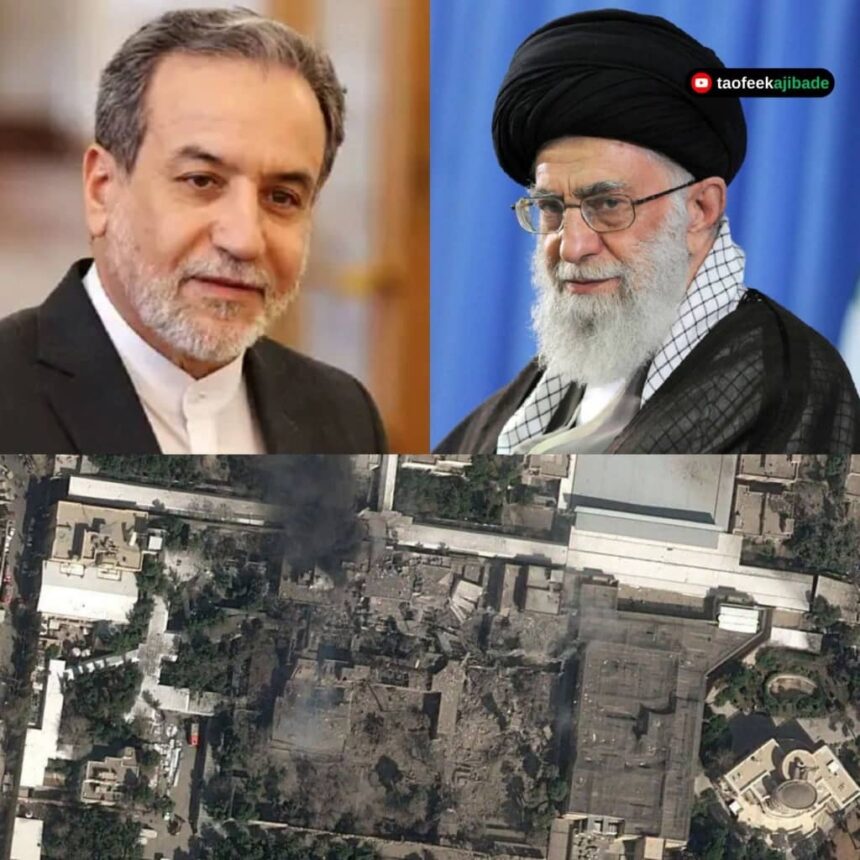
On the morning of 28 February 2026, Iranian Foreign Minister Abbas Araghchi arrived at the Supreme Leader’s compound at approximately 9:00 a.m. He had come directly from Geneva, carrying a briefing that the diplomatic atmosphere had deteriorated sharply and that war was now extremely likely.
He delivered that briefing to Ayatollah Ali Khamenei. Shortly afterward, the compound came under a US-Israeli strike.
The explosion devastated large sections of the facility. Araghchi was buried under the rubble. When he clawed his way out, his first thought, by his own account given to Al Mayadeen in June 2026, was not his own survival. It was the fate of the man he had just briefed.
What Araghchi found, or rather what he did not find, has become one of the defining images of this war.
Khamenei had known the strike was coming. Iranian intelligence had read the deteriorating signals. He had been warned, as Araghchi’s own briefing made clear, that the probability of military action was extremely high.
The underground shelters were available. His security detail would have insisted. And yet, according to Araghchi’s account, the Supreme Leader of the Islamic Republic remained at his desk and continued working until the bombs arrived.
That decision, whether viewed as an act of extraordinary defiance, a calculated piece of martyrdom politics, or simply the choice of an old man who had long made peace with his own mortality, fundamentally disrupted the strategic logic of the assassination.
The strike was designed not merely to kill a leader but to decapitate a state, to produce the paralysis, the fracture, the collapse of institutional coherence that would follow the violent removal of an irreplaceable figurehead. Iran’s adversaries had studied the model. Remove the head, and the body cannot organise itself fast enough to respond.
The body organised itself within hours.
Leadership transferred to Mojtaba Khamenei. Araghchi, still covered in the dust of the compound, spent the next forty days without returning home, managing Iran’s diplomatic posture across multiple simultaneous theatres. The IRGC’s command structure held. The missile programme accelerated. The resistance did not pause to grieve.
Removing a leader is one thing. Breaking the state that stands behind him is another.
Iran’s adversaries have encountered this truth before, in sanctions that produced resilience rather than collapse, in assassinations that produced successors rather than vacuums, and now in a strike that produced a symbol rather than a surrender.
The image of an aging Supreme Leader refusing to leave his desk while the coordinates were being locked in is not a footnote to this war. It is its defining moral architecture.
It tells you everything about why the bombs did not break what they were designed to break, and why the men who ordered them are now sitting at a negotiating table they swore they would never need.