


By Adeleke Nurudeen Adepoju
Al-Habibiyyah Islamic Society has taken another significant step in its efforts to position Waqf as a sustainable instrument for wealth preservation, social development, and poverty reduction in Nigeria.
Since 2025, the Islamic organisation has been championing awareness and innovation around Waqf, an Islamic endowment system that has historically supported education, healthcare, social welfare, and economic development across Muslim societies.
The organisation’s journey began with a monthly Waqf Roundtable, created to educate the public about the concept of Waqf and highlight its distinction from other forms of Islamic giving, particularly Zakat and Sadaqah Jariyah.
Learning From Global Waqf Institutions
Recognising that the development of a sustainable Waqf ecosystem requires learning from successful models around the world, Al-Habibiyyah Islamic Society extended its engagement beyond Nigeria.
Its teams visited charitable institutions in Malaysia and Türkiye, while a delegation, which included the author, also visited Morocco to gain first-hand insight into how Waqf operates in practice.
One of the notable institutions visited was Al-Qarawiyyin University in Fez, Morocco. Founded in 859 CE, the institution is widely recognised by UNESCO and historians as one of the world’s oldest continuously operating educational institutions.
Its centuries-long history provides a compelling illustration of how institutions established on sustainable endowments can survive and serve communities across generations.
A New Chapter for Waqf in Nigeria
That learning journey has now translated into a new phase of innovation.
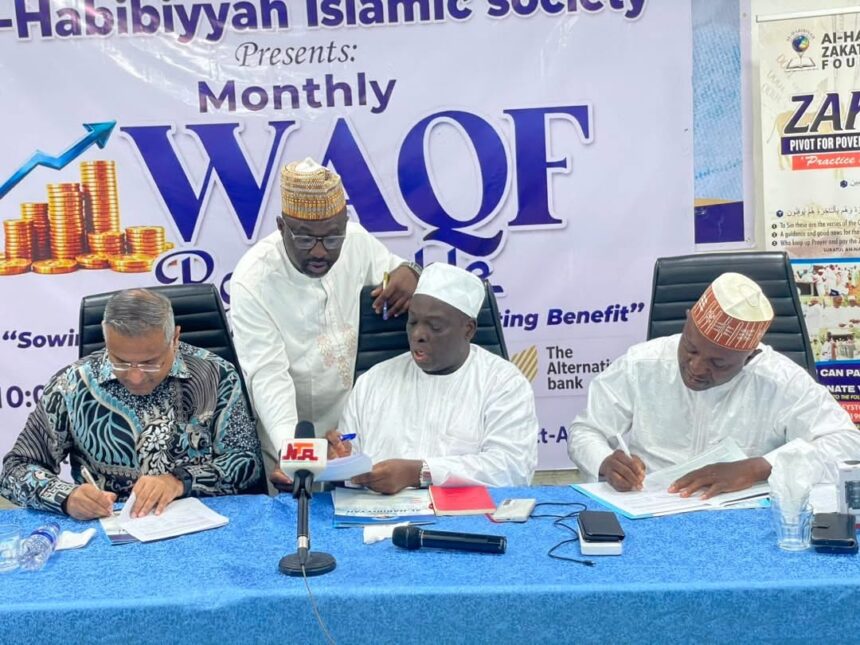
Only last week, Al-Habibiyyah Islamic Society signed a landmark Memorandum of Understanding (MoU) with FIUSS, a Malaysian technology company, to advance Waqf and blockchain innovation in Nigeria.
The partnership is aimed at exploring how emerging technologies can strengthen Islamic philanthropy, sustainable development, and Shariah-compliant financial innovation.
FIUSS provides Shariah-compliant fintech infrastructure and technology solutions. Under the new collaboration, the company will leverage Web3 solutions for the tokenisation of Islamic Capital Market (ICM) instruments and Real-World Assets (RWAs).
The initiative is expected to open new possibilities for developing a Waqf ecosystem that is more transparent, scalable, sustainable, and accessible.
Beyond Technology
For Al-Habibiyyah Islamic Society, however, the partnership represents more than a technological advancement.
It is an attempt to build an ecosystem where faith, technology, and sustainable development converge to create lasting social impact.
The broader vision is to establish a new generation of Waqf in Nigeria—one capable of preserving wealth, creating economic opportunities, funding critical development initiatives, and serving communities long after its founders are gone.
Historically, Waqf has demonstrated its ability to support institutions and communities across generations. The emerging model seeks to combine that enduring principle with modern financial and technological infrastructure.
Positioning Nigeria for the Future
As Islamic philanthropy continues to evolve globally, the need for innovative and sustainable approaches to addressing poverty and inequality has become increasingly important.
For Nigeria, where millions of people continue to face economic and social challenges, a properly structured Waqf ecosystem could provide an additional avenue for mobilising private wealth toward sustainable community development.
The partnership between Al-Habibiyyah Islamic Society and FIUSS therefore marks more than the signing of another corporate agreement. It represents a step toward building the infrastructure required to modernise Waqf and unlock its potential as a long-term development tool in Nigeria.
The journey that began with Waqf awareness is now entering a new phase—Waqf innovation.
And when successfully implemented, the vision is clear: a Waqf that preserves wealth, creates opportunities, funds development, and outlives generations.
The future of Islamic philanthropy is evolving, and Nigeria must not be left behind.