


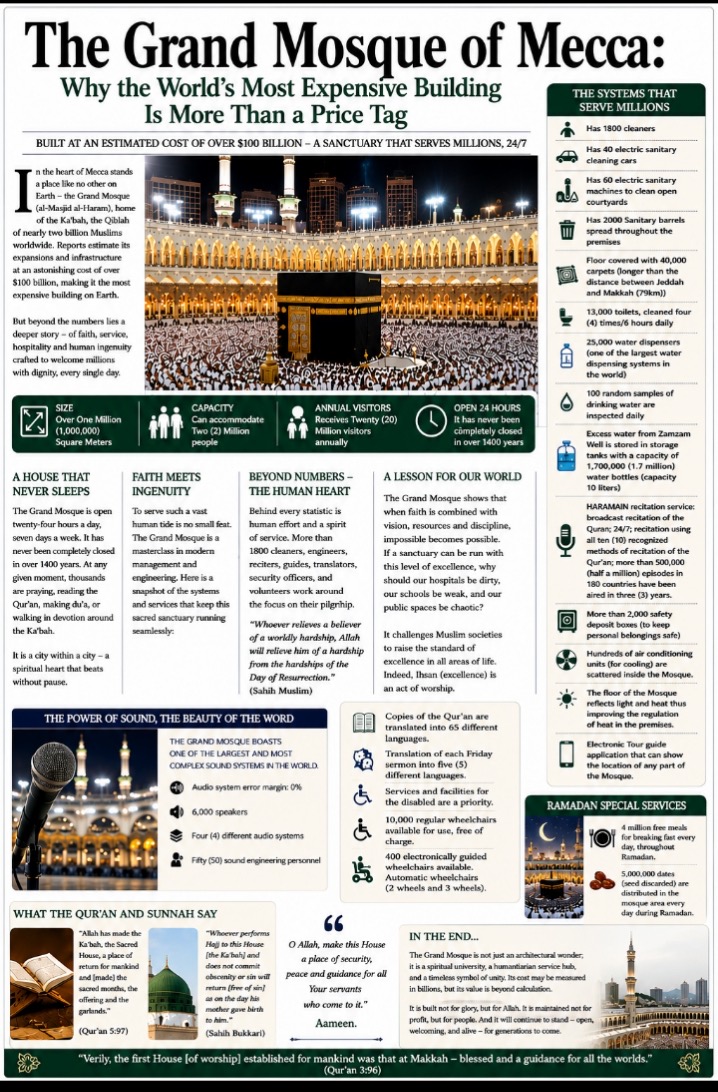
Often described as the most expensive building on earth, the Grand Mosque of Mecca is far more than a vast and costly structure. Beneath the marble, the billions and the astonishing logistics lies a deeper story — of sacred history, worship, service, discipline and the daily task of receiving millions of pilgrims before the House of Allah with dignity and care.
By Abdulkarim Abdulmalik
Before dawn breaks over Mecca, the Grand Mosque is already awake.
The marble floors of al-Masjid al-Haram glow under soft light. Around the Ka‘bah, thousands of worshippers move in steady circles, each carrying a private burden, a personal hope, a silent prayer. Some whisper verses of the Qur’an through tears. Some sit quietly after Tahajjud, staring at the House of Allah as if still trying to believe they are truly there. Some raise trembling hands in du‘a, asking for forgiveness, healing, provision, children, peace, or simply the strength to begin again.
Around them, another kind of movement is already underway. Cleaners, guides, technicians, wheelchair attendants, security staff and administrators move across the vast sacred precinct, preparing for the next wave of worshippers. In Mecca, devotion and duty begin early. The sanctuary must be ready before the crowd arrives.
That image — worship at the centre, service all around it — may be the best way to understand the Grand Mosque of Mecca, often described as the most expensive building on earth, with estimates placing the total value of its expansions, infrastructure and facilities at around $100 billion.
It is a figure that immediately captures attention. It belongs to the world of mega-cities, royal palaces, giant airports and financial powerhouses. Yet here it is attached not to a seat of state authority or a monument to luxury, but to a mosque — the holiest sanctuary in Islam, the home of the Ka‘bah, and the direction toward which nearly two billion Muslims turn in prayer every day.
Still, to reduce the Grand Mosque to its price tag is to misunderstand it.
For Muslims, al-Masjid al-Haram is not simply a massive building with a remarkable budget. It is the spiritual heart of the Ummah, the sacred precinct surrounding the first House established for the worship of Allah, the centre of Hajj and Umrah, and a place where faith, history, architecture, logistics and human longing meet in extraordinary ways.
Its deeper story is not about how much it costs. It is about what it is built to carry.
A Sanctuary at the Centre of Muslim Life
Every faith has places of memory. Every civilisation has spaces that rise above ordinary geography and enter the realm of symbol. For Islam, there is no earthly site more central than the Grand Mosque in Mecca.
At the heart of the mosque stands the Ka‘bah, the Qiblah toward which Muslims around the world face in prayer five times a day. It is around this sacred centre that millions perform tawaf, and toward it that the global Muslim community turns in one of the most visible symbols of spiritual unity in human history.
The Qur’an gives the House in Makkah a singular place in the story of worship:
“Indeed, the first House [of worship] established for mankind was that at Bakkah — blessed and a guidance for the worlds.” (Qur’an 3:96)
That verse does more than identify the Ka‘bah as an ancient sanctuary. It frames it as a blessing and a guidance for humanity. In other words, the sacredness of the House is not merely historical. It is moral, spiritual and civilisational.
The story begins with Prophet Ibrahim (AS) and Prophet Ismail (AS), who raised the foundations of the House in obedience to Allah. The Qur’an preserves their prayer:
“And [mention] when Ibrahim was raising the foundations of the House and [with him] Ismail, [saying], ‘Our Lord, accept [this] from us. Indeed, You are the Hearing, the Knowing.’” (Qur’an 2:127)
This origin matters. The Ka‘bah was not built as an exhibition of wealth or power. It was built as an act of submission. It began with prayer, humility and obedience — a reminder that the holiest things in life are not always born of grandeur, but of surrender to God.
From there came the command that turned Makkah into the destination of believers across generations:
“And proclaim to the people the Hajj; they will come to you on foot and on every lean camel; they will come from every distant pass.” (Qur’an 22:27)
Every Hajj season, that divine promise is fulfilled again. They come from every distant pass — from Nigeria, Indonesia, Egypt, Pakistan, Senegal, Turkey, India, Bosnia, Britain and beyond — answering a call first proclaimed by Ibrahim and renewed in the lives of millions with the cry: Labbaik Allahumma Labbaik.
Why the Numbers Matter
The viral fascination with the Grand Mosque is understandable. Its scale is difficult to comprehend. The complex is associated with vast prayer areas, the capacity to receive around two million worshippers during peak periods, extensive marble courtyards, huge Zamzam distribution systems, massive sanitation facilities, large-scale cooling infrastructure, multilingual services, wheelchair support, and teams of workers operating around the clock.
These numbers often circulate on social media as isolated facts — so many carpets, so many toilets, so many water dispensers, so many cleaners, so many wheelchairs. Some of the claims vary in precision and are repeated with little context, but the underlying reality is undeniable: the Grand Mosque is one of the most intensively serviced religious spaces on earth.
And it has to be.
This is not a neighbourhood mosque serving a fixed congregation. It is a sanctuary that receives the Muslim world in motion. It must accommodate the elderly woman from Kano who spent years saving for Hajj, the first-time pilgrims from Ihima, Idah and Ilorin in Nigeria who have only seen the Ka‘bah in photographs, the grieving widow from Sudan praying for her dead, the Indonesian family on Umrah, the disabled worshipper needing mobility support, the exhausted traveller Accra arriving after a long flight, and the non-Arabic speaker Enugu struggling to navigate the vast precinct.
In that context, infrastructure is not a luxury. It is an act of service.
The pilgrim who comes to Mecca does not only need spiritual elevation. He needs water. He needs cleanliness. He needs shade from the heat. He needs order. He needs signage and guidance. If he is elderly or disabled, he needs assistance that preserves dignity rather than erodes it. If the crowd is dense, he needs a system that protects life and prevents chaos.
So when people ask how a mosque can cost so much, the answer lies not only in architecture but in responsibility. The Grand Mosque is expensive because hospitality at this scale is expensive. Sacred service for millions requires organisation, maintenance, technology, expansion and constant human labour.
More Than Marble: The Practical Side of Mercy
One of the most important things the Grand Mosque reveals is that spirituality at scale cannot survive on sentiment alone.
There is a tendency in many Muslim societies to treat religion as if sincerity is enough — as if devotion can substitute for planning, and piety can excuse poor administration. The Haram quietly disproves that every day.
A mosque that receives millions cannot be managed on emotion alone. It must be cleaned constantly. Its water must be safe. Its prayer spaces must be orderly. Its sound systems must function. Its elderly worshippers must be assisted. Its disabled pilgrims must not be left behind. Its crowd flow must be managed. Its heat must be controlled. Its facilities must be maintained.
In other words, worship at this scale requires systems.
This is not a secular intrusion into religion. It is part of the ethics of care embedded in Islam itself. The Prophet Muhammad (SAW) said:
“Make things easy and do not make them difficult; give glad tidings and do not drive people away.” (Sahih al-Bukhari; Sahih Muslim)
That hadith is not limited to speech. It also speaks to the environment in which worship takes place. A pilgrim who arrives thirsty, confused, overwhelmed or physically weak should not be met with disorder if order can be created. The effort to make worship easier — through cleanliness, accessibility, water, guidance and safety — is itself a form of service to the faith.
In this sense, the Grand Mosque offers a practical lesson in mercy. It demonstrates that compassion is not only preached from the pulpit; it can also be built into systems.
The House That Never Sleeps
If there is one phrase that captures the spirit of the Grand Mosque, it is this: it is a house that never truly sleeps.
At Fajr, the mosque is alive with recitation. At Dhuhr, fresh waves of worshippers arrive. After ‘Isha, the tawaf continues. In Ramadan, the crowds swell deep into the night, especially in the final ten days when hearts cling to every prayer in search of Laylat al-Qadr. During Hajj, the human tide becomes one of the most extraordinary annual gatherings on earth.
This uninterrupted life gives the Grand Mosque a unique moral force. Many of the world’s most impressive buildings are monuments to wealth, political power or national prestige. The Grand Mosque is something else: it is a monument to return.
It is the place to which Muslims return in prayer every day, and in pilgrimage if they are able. It is a sanctuary for gratitude, repentance, longing and spiritual repair. Some arrive there after years of saving. Some arrive carrying grief. Some come to ask for children, healing, guidance or forgiveness. Some come because the world has become too heavy and they need a place where the heart can speak honestly to God.
And what they find is a sanctuary that still receives them.
That is part of what makes the Grand Mosque so powerful. It is not only a site of ritual performance. It is a refuge for the wounded soul.
The Human Hands Behind the Holy Place
Yet one of the most overlooked dimensions of the Grand Mosque is the human labour that sustains it.
Behind every clean prayer space is a worker who cleaned it. Behind every orderly movement of pilgrims is a team that planned it. Behind every wheelchair made available to an elderly worshipper is a system designed to reduce hardship. Behind every clear recitation carried across the prayer halls is a sound engineer doing invisible work. Behind every drink of Zamzam is a chain of logistics. Behind every calm experience of worship is an army of service.
These people rarely appear in the popular imagination of Mecca. The photographs usually centre the Ka‘bah, the architecture, the crowds and the lights. But if the Haram teaches anything, it is that sacred spaces are also sustained by ordinary labour performed with extraordinary consistency.
In Islamic ethics, that matters deeply.
The Prophet (SAW) said:
“Whoever relieves a believer of a hardship of this world, Allah will relieve him of a hardship on the Day of Resurrection.” (Sahih Muslim)
What is assisting an elderly pilgrim if not relieving hardship? What is cleaning a prayer space for the next row if not relieving hardship? What is providing water, translation, guidance and access if not relieving hardship?
Seen this way, the Grand Mosque is not only a monument of worship. It is a vast ecosystem of service, where the invisible work of thousands helps protect the visible experience of devotion.
A compelling Appreciation
Behind the these complex interfaces of finance, management of human and material resources is the Kingdom of Saudi Arabia, the country’s Custodian of the Two Holy Mosques – Haram in Makkah and the Prophet’s Mosque in Madinah – King Salman bn Abdul Aziz Al-Saud, his predecessors, and the very good and highly receptive people of the Kingdom. To them, the entire Muslim World owe compelling Appreciation and gratitude.
Beyond sustaining the standard facilities, they ensure concerted improvements are put in place; just to make sure that the Pilgrims are comfortable as the Honourable Guest of Allah.
A Challenge to Muslim Societies
The Grand Mosque also raises a difficult question for the wider Muslim world.
If Muslims can organise such seriousness around Hajj and Umrah, why do so many Muslim societies still struggle with the basics of public order? Why are hospitals often dirty, schools poorly maintained, roads unsafe and public institutions disorganised? Why is excellence sometimes reserved for symbolic moments of religion while everyday civic life is left to decay?
Nigeria, like many Muslim-majority or Muslim-influenced societies, must ask itself that question honestly.
We speak often of piety. We send pilgrims every year. We quote Qur’an and Hadith with ease. But do we bring the same seriousness to public sanitation, care for the elderly, accessibility for the disabled, disciplined administration, or the maintenance of public spaces? Do our institutions reflect the prophetic ethic of easing hardship for people? Or do we too often burden people with neglect and call it destiny?
The lesson of the Grand Mosque is not that every country must spend billions. Most cannot. The lesson is that service matters, systems matter, cleanliness matters, accessibility matters, and public excellence is not alien to Islam. On the contrary, when a society takes worship seriously, it should also take the welfare of people seriously.
The Haram is a reminder that faith and organisation are not enemies. They are partners.
The Tension Between Grandeur and Humility
Still, admiration for the Grand Mosque should not prevent honest questions.
Modern Mecca exists within a landscape of luxury hotels, elite accommodation and commercial development that has unsettled many Muslims. There is a visible tension between the spiritual simplicity of Hajj and the economics of contemporary pilgrimage. The rites of Hajj strip the pilgrim of status through the ihram, but the wider environment of modern Mecca can still reflect the inequalities of wealth and access.
This tension matters because pilgrimage is supposed to humble the powerful and reassure the weak that all stand equal before Allah. The spiritual essence of Hajj lies in surrender, not spectacle. It lies in remembrance, not luxury.
So the moral challenge surrounding the Grand Mosque is not whether it should be maintained, expanded or modernised. Clearly, it must be. The challenge is whether expansion remains rooted in service rather than vanity; whether convenience overwhelms humility; whether the sacred is protected from becoming merely another market.
That is not an easy balance to strike. But it is one that must remain at the centre of any honest conversation about Mecca in the modern age.
More Than a Price Tag
In the end, the Grand Mosque of Mecca matters not because it may be the most expensive building on earth, but because it represents something deeper than money can measure.
You can count the square metres, the water dispensers, the wheelchairs, the toilets, the carpets, the cooling systems and the annual visitor numbers. You can estimate the cost of expansions and the scale of its infrastructure. But you cannot calculate what it means for a weary believer to stand before the Ka‘bah after a lifetime of longing. You cannot put a price on the tears of a pilgrim who feels that Allah may still forgive him. You cannot measure the peace that settles in a heart that has wandered too far and finally finds its way back in sujud.
That is the true worth of the Grand Mosque.
At the centre of this vast, expensive, carefully managed sanctuary stands the Ka‘bah — simple, black-draped, ancient, and unchanged in its essential meaning. Around it rise the systems of a modern world: marble, sound, light, cooling, sanitation, translation, security and service. But the heart of the place remains what it always was: a call to tawhid, humility and return.
The billions spent on the Grand Mosque did not make it sacred. Allah made it sacred. What those billions can do — and what they must continue to do — is help millions of His servants worship there with dignity, safety and ease.
In a world where enormous wealth is often spent on vanity, violence and excess, there is something profoundly moving about the fact that one of humanity’s costliest built spaces is, at its core, a place where people come to bow, to repent, to hope, to remember and to begin again.
Not a monument to man’s greatness.
But a reminder of man’s need for God.