


By Abdulkarim Abdulmalik
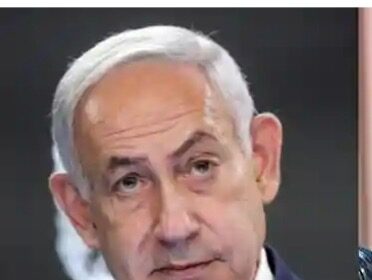
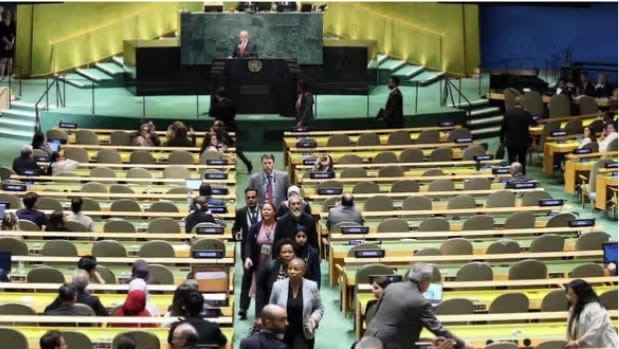
The most revealing image from Benjamin Netanyahu’s latest appearance before the United Nations General Assembly may not have been the Israeli prime minister standing at the podium. It was the sight of diplomats leaving the chamber as he began to speak.
Dozens of delegations walked out during Netanyahu’s address on September 24, 2026, leaving a significantly depleted chamber behind. Reuters described the walkout as an indication of the mounting international criticism confronting Netanyahu over Israel’s war in Gaza.
That image deserves to be understood beyond the sensational language of an “empty UN hall.” The chamber was not literally empty, and describing those who departed simply as “world leaders fleeing the room” is imprecise. But the political symbolism of the walkout was unmistakable: a significant number of governments and diplomatic representatives were unwilling to remain in the chamber for Netanyahu’s address.
The larger story, therefore, is not simply Netanyahu versus his critics. It is the widening international controversy over Israel’s conduct in Gaza and the increasingly difficult diplomatic environment in which the Israeli government now finds itself.
Gaza, the Shadow Over the Speech
Netanyahu’s appearance came against the background of a devastating and prolonged conflict in Gaza. UN Secretary-General António Guterres, speaking earlier during the 81st General Assembly, described the scale of killing and destruction in Gaza as unlike anything he had witnessed during his years as Secretary-General. He also referred explicitly to the International Court of Justice’s provisional measures in the genocide case concerning Gaza and called for compliance with international law. That context is essential!
The walkout should not be interpreted merely as a disagreement with Netanyahu’s personality or political style. It occurred against the background of an international argument over civilian deaths, displacement, humanitarian access, Israel’s military operations and the legal characterisation of those actions.
There is an important distinction here. Israel rejects allegations that it is committing genocide, arguing that its military campaign is directed against Hamas and that it seeks to protect Israeli civilians. Netanyahu used the UN platform to make precisely that case, rejecting accusations of genocide and presenting Israel’s actions as necessary self-defence.
But the fact that Israel disputes the allegation does not mean that the allegation itself can simply be dismissed. The genocide question is being addressed through international legal and political institutions, while UN officials continue to highlight the humanitarian catastrophe and obligations under international law.
The Walkout: A Political Message
When representatives from numerous countries leave the hall at the beginning of a national leader’s speech, the action itself becomes part of the diplomatic communication.
Reports indicate that representatives from countries including Türkiye, Palestine, Tunisia, Syria, Algeria, Egypt, Iraq, Saudi Arabia, Jordan, Iran, Qatar, Lebanon, Malaysia, Indonesia and Kuwait were among those participating in the protest.
It would nevertheless be an overstatement to interpret every departure as evidence that all those governments share exactly the same position on Israel or the Gaza war. Governments have different diplomatic calculations, and individual delegates may leave for different reasons.
But collectively, the walkout conveyed something difficult to ignore: Israel’s handling of the Palestinian question has become a major source of international diplomatic confrontation.
This is why the scene inside the UN chamber was more significant than the theatrical language surrounding it.
Netanyahu’s Answer was Defiance, not Retreat
Rather than treating the walkout as an indication that his message had failed, Netanyahu turned it into another argument.
He described those leaving as “moral cowards” and proceeded to deliver an aggressive defence of Israel’s policies. Contemporary reports also indicate that he rejected accusations of genocide and attacked critics of Israel, while praising Donald Trump and criticising political opponents including New York City Mayor Zohran Mamdani.
This was characteristic of the broader Netanyahu strategy: transform criticism of Israel into an argument about Israel’s right to defend itself.
But that strategy also reveals the central diplomatic problem.
The question increasingly confronting Israel is not simply whether Israel has a right to defend its citizens. Israel clearly does have security concerns, particularly following the Hamas attacks of October 7, 2023. The more difficult international question is how that right is exercised, what limits international humanitarian law imposes, and what obligations exist toward Palestinian civilians.
Those questions cannot be answered simply by invoking terrorism on one side or civilian suffering on the other. They require scrutiny of conduct under international law.
The Empty Seats: More Powerful than the Rhetoric
There was considerable theatricality in Netanyahu’s speech. He used visual props, including a pager, to make his arguments about Israel’s confrontation with Hezbollah, and he attacked several countries and political figures.
Such devices can generate headlines, but they risk obscuring the fundamental issue.
The most consequential image was not the pager. It was the diplomats leaving.
For Netanyahu, the walkout provided an opportunity to portray Israel as a country standing alone against what he considers misguided international opinion. For his critics, however, the departing delegations represented international rejection of the destruction and humanitarian suffering associated with Israel’s military campaign in Gaza.
Both interpretations are politically significant.
But there is another interpretation worth considering: the spectacle demonstrated how deeply divided the international system has become over Israel and Palestine.
Palestine, Impossible to Ignore
The diplomatic environment surrounding this year’s UN General Assembly also demonstrates that the Palestinian question has moved further toward the centre of international diplomacy.
Earlier in September, the General Assembly voted 152–3, with four abstentions, to allow the State of Palestine to participate virtually in the high-level debate after the United States, Israel and Paraguay voted against the measure.
That vote does not by itself establish a universal position on every aspect of the Israeli-Palestinian conflict. But it illustrates the breadth of support within the General Assembly for Palestinian participation in the UN system.
Meanwhile, Guterres has warned that violence, displacement and settlement expansion in the occupied West Bank are undermining prospects for peace and raising concerns about ethnic cleansing.
Consequently, Netanyahu’s speech was delivered in an international environment in which the Palestinian issue was already dominating diplomatic debate.
The Real Story: Diplomatic Isolation
The original description of Netanyahu’s appearance as a “shocking meltdown” is therefore less useful than a deeper analysis.
What happened at the UN was not simply a politician losing his audience. It was a dramatic manifestation of the widening gulf between the Israeli government’s justification of its military actions and the increasingly severe criticism directed at those actions internationally.
The walkout cannot resolve the Gaza conflict. Nor does it establish the legal responsibility of any individual or government. Those questions belong to diplomatic negotiations, investigations and judicial processes.
But it does provide a powerful snapshot of the current international mood.
The increasingly empty chamber was not merely an image of Netanyahu speaking without an audience. It was an image of a diplomatic system struggling to reconcile Israel’s security claims with the enormous Palestinian civilian toll and the demands of international law. That is the deeper story behind the spectacle.
The most important question arising from the UN drama is therefore not whether Netanyahu was embarrassed. It is whether Israel and its international partners can address the growing humanitarian, legal and diplomatic crisis surrounding Gaza before the distance between Israel and much of the international community becomes even harder to bridge.
– Abdulkarim Abdulmalik is an Abuja-based Journalist. Email: nowmalik@gmail.com