


America is an empire.
Iran, many believed, was not.
So the world assumed it would behave like a fragile state, reacting to crises rather than designing for them.
Long before tensions hardened into the daily grammar of geopolitics, a quiet doctrine began forming inside the Iranian military.
It grew inside the ranks of the Islamic Revolutionary Guard Corps, a force created after the Iranian Revolution to protect the new republic.
At the center of that thinking stood a man rarely known outside military circles.
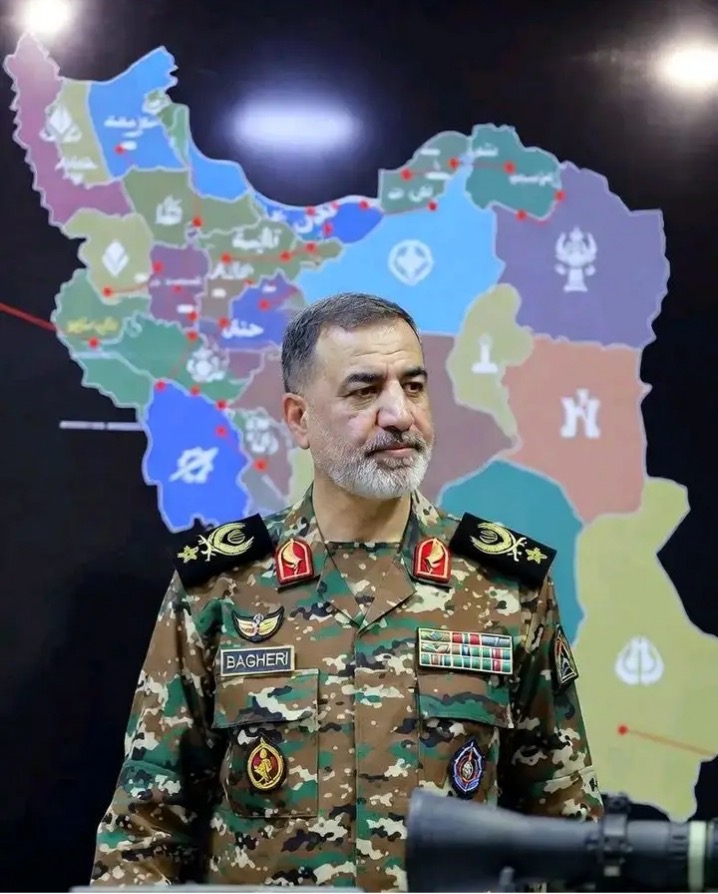
Mohammad Ali Bagheri.
Bagheri belonged to a generation shaped by war.
The long fire of the Iran–Iraq War had taught Iran one harsh lesson.
Armies collapse when their heads are cut off.
States fall when they depend on one command center.
So Iranian strategists began studying their enemies carefully.
The United States.
Israel.
NATO.
They asked a simple question.
How does a smaller power survive a superior one?
The answer was not strength.
It was structure.
Years earlier, the Chinese strategist Sun Tzu wrote that the greatest army is the one whose defeat cannot be completed.
Bagheri took that sentence seriously.
Inside military planning rooms in Tehran, maps of Iran’s provinces were spread across long tables.
Mountains.
Deserts.
Cities.
Oil routes.
Ports.
Every region studied like a chess square.
The plan that emerged later became known as the “mosaic doctrine.”
Instead of one rigid military command, Iran built many.
Local commands.
Provincial commands.
Independent operational units.
The Islamic Revolutionary Guard Corps reorganized itself into dozens of territorial commands across Iran’s provinces, each capable of operating even if the central leadership were destroyed.
In simple terms, the country became a battlefield designed to fight without waiting.
Each province a fortress.
Each commander empowered.
Each region prepared to continue war if Tehran itself were silenced.
A defense analyst, Farzin Nadimi of the Washington Institute, once described it bluntly.
“Each province is a mosaic,” he said.
“The commanders have the authority to make decisions.”
That authority carried a radical principle.
If war came.
If the Supreme Leader were killed.
If the capital lost contact.
The provinces would not pause.
They would fight.
Immediately.
A young officer once asked an older commander about this doctrine.
“General,” he said, “does that not create chaos?”
The general replied with a proverb common across East Africa.
“Kidole kimoja hakivunji chawa.”
One finger cannot kill a louse.
But many fingers together can.
This was not the strategy of an empire.
It was the strategy of a nation expecting invasion.
Iranian planners had studied what happened to Iraq in 2003.
The state collapsed when its command structure collapsed.
Iran resolved never to repeat that lesson.
Instead of a pyramid, they built a network.
Cut one node.
Others continue.
Recent reporting suggests this decentralization was designed precisely to survive leadership losses, allowing mid-level officers to continue operations even after senior commanders are killed.
In war theory, this is called resilience.
In politics, it is something else entirely.
Insurance.
Yet every strategy carries its shadow.
A Yoruba folktale tells of a hunter who trained many dogs so the hunt would never fail.
One day the dogs grew so skilled they no longer waited for the hunter.
They chased whatever moved.
Victory.
Chaos.
Both arrived together.
And that is the quiet question behind Iran’s system today.
A military designed never to stop fighting may indeed survive catastrophe.
But survival has its own price.
Because once every province learns how to wage war without waiting,
the hardest command to give
is the command to stop.
– kirimi