


By Dr. Jerry Igwilo
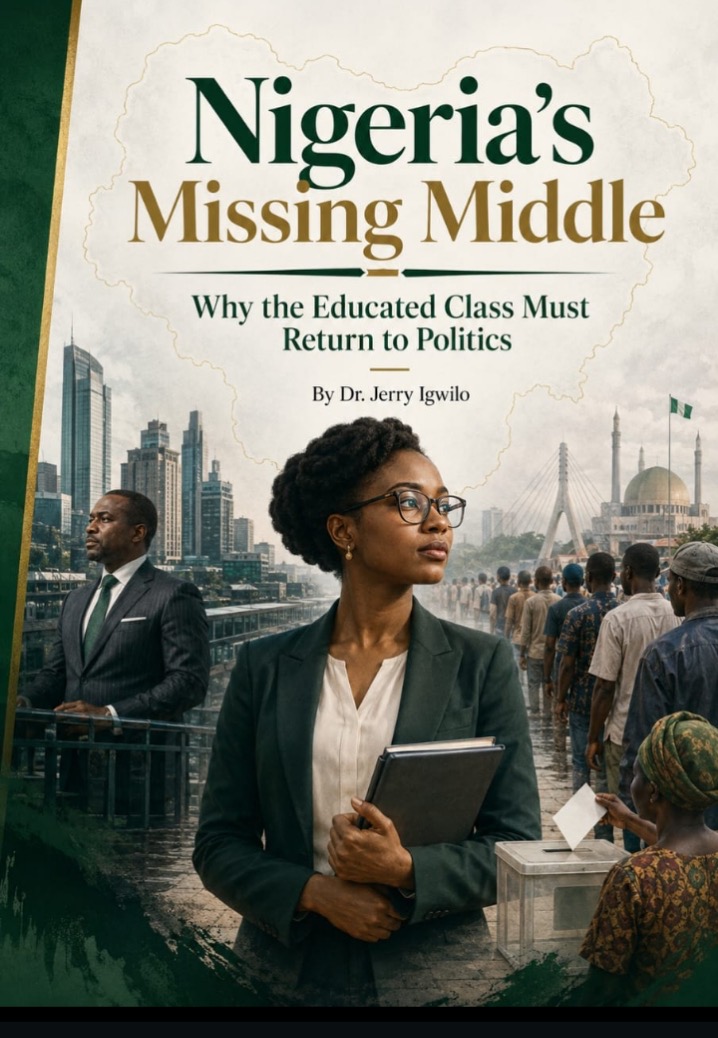
Nigeria’s political economy is not only divided by region, ethnicity, religion, or party affiliation. It is also divided by class. Beneath the noise of every election cycle sits a deeper social structure that shapes who contests power, who funds power, who complains about power, and who actually votes power into office.
In broad terms, Nigeria has three major economic groups: the upper class, the middle class, and the lower class. Each group relates to politics differently. Each group carries its own interests, fears, frustrations, and contradictions. Yet, of all these groups, the Nigerian middle class is perhaps the most important and the most politically absent.
This absence has consequences.
The upper class understands politics. The lower class participates in politics. The political class exploits politics. But the middle class, which suffers heavily from poor governance, often stays outside politics while expecting the country to work in its favour.
That contradiction is at the heart of Nigeria’s leadership crisis.
The Upper Class: Close to Power, But Rarely in the Queue
Nigeria’s upper class is financially stable, socially connected, and politically aware. Members of this class may not always stand under the sun on election day, but they understand where power is produced. They contribute money, influence, access, networks, logistics, media support, and elite endorsement to candidates and parties.
Many of them do not need to vote physically to matter politically. Their participation happens before election day. They host meetings. They fund campaigns. They introduce candidates to donors. They secure elite consensus. They advise, lobby, negotiate, and protect their interests.
In many cases, they are not victims of the system in the same way as the rest of society. If schools fail, their children are abroad or in expensive private schools. If hospitals fail, they fly out. If inflation rises, they adjust portfolios. If insecurity worsens, they hire private security. If policy becomes unfriendly, they lobby.
Their relationship with politics is therefore practical. They do not romanticise power. They understand it. They invest in it.
The Lower Class: The Decisive Voting Bloc
At the other end of the divide is the lower class. These are the citizens who bear the harshest weight of poverty, unemployment, inflation, poor infrastructure, insecurity, and weak public services. Many live on daily income. Survival is immediate. Hunger is not theoretical. For many of them, election day is not merely a civic ritual; it is also another day to find food, money, transport fare, or temporary relief.
This is where the political class has mastered the game.
Politicians understand that poverty weakens the bargaining power of citizens. They understand that a hungry voter may not think in terms of long-term national transformation. A hungry voter may think first about rice, cash, transport money, noodles, or a small favour that solves a problem for one day.
This is not because the poor are less intelligent. It is because deprivation changes political behaviour. When daily survival becomes the main priority, the future becomes negotiable.
The political class knows this and exploits it. They arrive during elections with gifts, cash, promises, identity appeals, and fear. They convert poverty into political capital. They treat the poor not as citizens to be lifted, but as electoral machinery to be activated.
There is also another dimension. Many within the lower class are deeply resentful of the middle class. They see the middle class as the immediate face of inequality. The middle class employs them, supervises them, pays them poorly, speaks down to them, and often lives just far enough above them to become a target of anger. The poor may not directly meet the billionaire or the politician who built the system, but they meet the middle-class employer, landlord, manager, professional, shop owner, and civil servant.
So, while the middle class complains about bad governance, many poor voters do not necessarily see them as allies. That social distance matters.
The Middle Class: Educated, Loud, Angry, and Absent
Then comes the Nigerian middle class. This is the most educated, most vocal, most digitally active, and arguably most frustrated segment of society. It includes professionals, entrepreneurs, lecturers, bankers, doctors, lawyers, tech workers, civil servants, small business owners, students, creatives, and young graduates trying to build a life in an unstable economy.
This group feels government policy very directly. Exchange rate instability affects their savings. Inflation destroys their purchasing power. Fuel prices affect their movement. Interest rates affect their businesses. Poor electricity affects their productivity. School fees rise. Rent rises. Food prices rise. Medical bills rise. The cost of hope itself rises.
Yet, despite this heavy exposure to fiscal and monetary decisions, the middle class often remains politically passive.
It complains loudly, but organises weakly.
It understands the pain of bad policy, but not always the machinery of power.
It dominates social media debates, but often underperforms at ward meetings, party congresses, voter mobilisation, candidate recruitment, and election-day participation.
It wants good governance, but many of its members do not want to enter the difficult, messy, patient, and sometimes frustrating work of politics.
This is the great contradiction.
The Nigerian middle class wants a better country, but too often treats politics as something beneath it. It wants responsible leaders, but does not always take responsibility for leadership recruitment. It wants a clean system, but avoids the arena where the system is shaped. It wants competent governance, but allows the least competent people to dominate party structures, candidate selection, and grassroots mobilisation.
A country cannot be rebuilt by complaints alone.
The Escape Mentality and the Politics of Disconnection
A major part of the middle-class crisis is the escape mentality. Many young, educated Nigerians are constantly planning to leave the country. For them, Nigeria is not a project to repair, but a problem to escape.
This feeling is understandable. The country has disappointed many of its citizens. It has frustrated ambition, wasted talent, punished honesty, and made dignity expensive. Many who leave do so because they are tired, afraid, underpaid, or simply seeking a fairer environment.
But there is a deeper question the middle class must confront: if everyone who understands the problem leaves the field, who will rebuild the country?
A growing number of Nigerians now live in the United States, the United Kingdom, Canada, Europe, South Africa, and other parts of the world. Many of them are doing well. They have access to better systems, stronger institutions, and more predictable public services. But some of them have become even more hostile to Nigeria than those who remain at home.
They speak of Nigeria with contempt. They mock the country. They insult those who still believe it can work. They forget that many of them were formed by Nigeria, educated by Nigeria, supported by Nigerian families, and shaped by communities that made sacrifices for their rise.
Their peers in their new countries are entering public life, contesting elections, shaping policy, advising governments, building institutions, and influencing national direction. Meanwhile, many Nigerian professionals abroad have reduced their relationship with Nigeria to criticism, remittances, occasional outrage, and holiday visits.
That is not enough.
Diaspora success should not become national detachment. Leaving Nigeria physically does not require abandoning Nigeria emotionally, intellectually, politically, or economically. The Nigerian diaspora has capital, knowledge, exposure, and influence. It can support reform-minded candidates, fund civic education, mentor young leaders, invest in local institutions, influence policy debates, and help build a more serious political culture.
But that will not happen if the dominant emotion remains contempt.
Nigeria needs correction, not hatred. It needs honest criticism, not bitterness without responsibility.
Why the Middle Class Must Understand Political Economy
One of the great weaknesses of the Nigerian middle class is that many understand politics emotionally but not structurally. They know when they are angry, but not always why the system produces the same outcomes. They know prices are rising, but may not connect monetary policy, exchange rates, subsidy choices, productivity, imports, insecurity, taxation, and fiscal deficits. They know leaders are failing, but may not understand how parties select candidates, how local structures control delegates, how vote buying works, or how elite bargains shape national choices.
Politics is not only about voting for a good person during a presidential election. Politics begins much earlier.
It begins at the ward level.
It begins with party membership.
It begins with local government engagement.
It begins with candidate recruitment.
It begins with funding credible aspirants.
It begins with monitoring budgets.
It begins with civic education.
It begins with building coalitions across class, religion, region, profession, and generation.
It begins with understanding that power does not respect moral superiority. Power respects organisation.
The middle class must stop assuming that intelligence alone can defeat structure. It cannot. Good intentions without organisation will lose to bad intentions with structure.
The Political Class and the Management of Division
Nigeria’s political class has mastered the art of managing these class divisions. It understands that the upper class can be negotiated with, the lower class can be mobilised through survival incentives, and the middle class can be distracted, divided, exhausted, or ignored.
This is why the same political patterns repeat themselves.
The poor are activated during elections.
The rich negotiate before and after elections.
The middle class argues online.
Then, after the election, the middle class returns to outrage, disappointment, economic pressure, migration plans, and political sarcasm.
This cycle cannot produce a serious country.
The political class will not voluntarily surrender space. It will not suddenly become accountable because citizens are angry on social media. It will not rebuild institutions because professionals are frustrated. It will not reform party structures because educated people are complaining from the sidelines.
Power yields only when citizens organise, contest, fund, monitor, negotiate, and sustain pressure.
What the Middle Class Must Do Now
The Nigerian middle class must reimagine its role in national life. It must move from complaint to participation. From anger to organisation. From detachment to ownership. From election-season excitement to permanent civic engagement.
This means joining political parties, not only supporting candidates from outside. It means participating in ward meetings, not only analysing presidential debates. It means helping credible people run for councillorship, chairmanship, state assembly, national assembly, and governorship positions. It means funding politics legally and transparently, because politics without money is often captured by those with questionable money.
It also means engaging the lower class with respect. The middle class cannot win Nigeria by insulting poor voters. It must understand their fears, their hunger, their anger, and their survival logic. It must build trust with them before election day. It must show them that good governance is not an elite slogan, but the difference between poverty and dignity.
The middle class must also stop treating politics as dirty while expecting clean people to emerge from it. If decent citizens avoid politics because it is dirty, then politics will remain in the hands of those who benefit from dirt.
The Country the Middle Class Wants Requires Its Participation
The ideal Nigeria that many educated citizens dream about will not appear by accident. It will not be built by hashtags alone. It will not be delivered by foreign governments, donor agencies, motivational speeches, or diaspora commentary. It will not emerge because citizens are tired. Many societies remain tired for generations.
Countries change when citizens decide to pay the price of participation.
The Nigerian middle class has education, exposure, energy, professional skill, and digital reach. It can become a major force in national renewal. But first, it must abandon political laziness disguised as sophistication. It must stop standing outside the arena while complaining about those inside it.
The upper class already understands power.
The lower class already votes.
The political class already organises.
The missing force is the middle class.
And until the Nigerian middle class returns to politics with seriousness, discipline, funding, structure, patience, and patriotism, it will continue to suffer from decisions made by people it refuses to challenge properly.
Nigeria does not need a middle class that only complains.
Nigeria needs a middle class that participates, organises, contests, funds, educates, monitors, and leads.
That is where national rebuilding begins.
“Change begins with ME “