


Sixteen days of oil. Two straits, not one. And the same reckless calculation Keynes watched destroy Europe in 1919 — now repeated by a new Big Three in Washington, Jerusalem, and the Gulf.
By Lim Tean
A note before we begin: I wrote most of what follows yesterday, as an argument about the Strait of Hormuz alone, drawing on Keynes and the Treaty of Versailles to make a point about how wars generate bills that get paid long after the guns fall silent. Overnight, the story changed under my feet — and not for the better. What was a one-strait crisis is now a two-strait crisis, and I have rewritten the piece to reflect it. I have also expanded on Keynes himself — who he was, what he saw in Paris, and why I think the parallel to today is closer than most people are willing to say out loud. Some of what follows is straight economic and maritime analysis; some of it is my own view of how we got here, and who I hold responsible. I have tried to keep those two things clearly separated so you can judge each on its own terms.
America’s entire emergency oil reserve now covers sixteen days. Sixteen. The world spent four decades building a shock absorber for exactly this war — and burned it down in five months. What comes next isn’t just a higher petrol price. It’s a bill mailed to every fragile economy on earth, at the worst possible moment to receive one.
And as of this morning, the bill just got larger. Overnight, the Houthis struck two Saudi oil tankers — the Encelia and the Layla — in the Red Sea, claiming they had violated a maritime embargo the group declared against Saudi-linked shipping earlier this week. That follows yesterday’s development, which I think has not been given nearly enough weight: six Saudi tankers turned back before reaching Bab al-Mandeb rather than risk the transit. The UK Maritime Trade Operations centre has confirmed reports of at least one vessel struck and on fire.
Put those two facts together and you get something more serious than a shipping incident. You get a demonstration. The Houthis are showing the market that their announced blockade of the southern Red Sea is not a threat on paper — it is operational, and it works. Ships are already turning back on their own before a single missile is fired at them. That is what a functioning blockade looks like in its early days: not universal destruction, but universal caution, which achieves the same economic result at a fraction of the cost to the blockading party.
This matters enormously because of what Bab al-Mandeb has been doing for the world since February. It has been the release valve.
Two Chokepoints, One Failing System
Since Iran’s closure actions in the Strait of Hormuz escalated, Saudi Arabia has quietly rerouted millions of barrels a day through pipelines to its Red Sea port at Yanbu, sending them out through Bab al-Mandeb instead. Exports from Yanbu surged to roughly 3.5 million barrels a day in June, up from a mere 240,000 a year earlier. That is not a minor adjustment. That is the mechanism by which the world has avoided a full-blown Hormuz-only oil shock — Riyadh built itself a back door, and the market leaned on it hard.
A Houthi blockade closes that back door. And unlike Hormuz, where Iran has state-level incentives to eventually de-escalate and a formal ceasefire architecture to negotiate around, the Houthis operate with a looser command structure, a narrower set of grievances, and far less to lose diplomatically. Iran can be talked down by chancelleries. The Houthis have shown, over a decade of war, that they are considerably harder to talk down — and their stated goal here is explicitly to force economic capitulation from Riyadh, not to extract a seat at any table.
So what we are looking at, this morning, is not “the Hormuz crisis, plus a bit of noise in the Red Sea.” It is the near-simultaneous closure, in practical terms, of both of the world’s critical Middle Eastern oil arteries — the direct one and the one everybody was quietly using to route around the first closure.
The Economic Consequences of the War
It is worth remembering who Keynes actually was when he wrote this, because it is not the work of an armchair critic. He was there. As the senior British Treasury representative at the Paris Peace Conference, and deputy for the Chancellor of the Exchequer on the Supreme Economic Council, Keynes sat inside the room while Woodrow Wilson, David Lloyd George, and Georges Clemenceau decided the shape of the postwar world. He had hoped the conference would set the conditions for Europe’s economic recovery. Instead he watched it become a negotiation almost entirely about borders, national security, and the size of the bill to be handed to Germany.
He was, by every account, disgusted by what he saw. He resigned his position in June 1919, in protest, before the treaty was even signed — telling colleagues he could no longer put his name to a policy he believed would ruin Europe.
His friend Virginia Woolf recorded him describing the whole process as a “dismal and degrading spectacle.” He left Paris for a farmhouse in Sussex and, in a matter of weeks, wrote the book that would make him the most famous economist in the world.
His argument was blunt: the reparations being demanded of Germany were not merely harsh, they were arithmetically impossible. Germany could not generate the trade surpluses required to pay them without wrecking the very European economy the Allies claimed to be rebuilding. Keynes warned this would not stay a German problem. An impoverished, resentful Germany, stripped of the means to recover, would become a source of political instability for the whole continent — and he said so in 1919, in print, twenty years before anyone needed convincing.
He was, of course, entirely vindicated. Germany’s economy did collapse under the weight of reparations and the hyperinflation that followed. The resentment Keynes predicted did take root. And the political movement that fed on that resentment was the one that produced Hitler and, within a generation, the Second World War. Few economists in history have had a prognosis confirmed so completely, or so tragically.
Part of what made the book so devastating on publication was that Keynes did not spare the men responsible. He drew biting, unflattering portraits of the statesmen at Versailles — Wilson as a rigid, self-righteous idealist outmanoeuvred by more cynical operators; Lloyd George as a brilliant tactician with no fixed convictions, bending with whatever the room demanded; Clemenceau as a hardened cynic who wanted Germany broken and cared little for the economic consequences, so long as France was safe. Keynes had watched all three up close, and his verdict was that they had let politics take precedence over economics, with a bill that would come due long after they had left office.
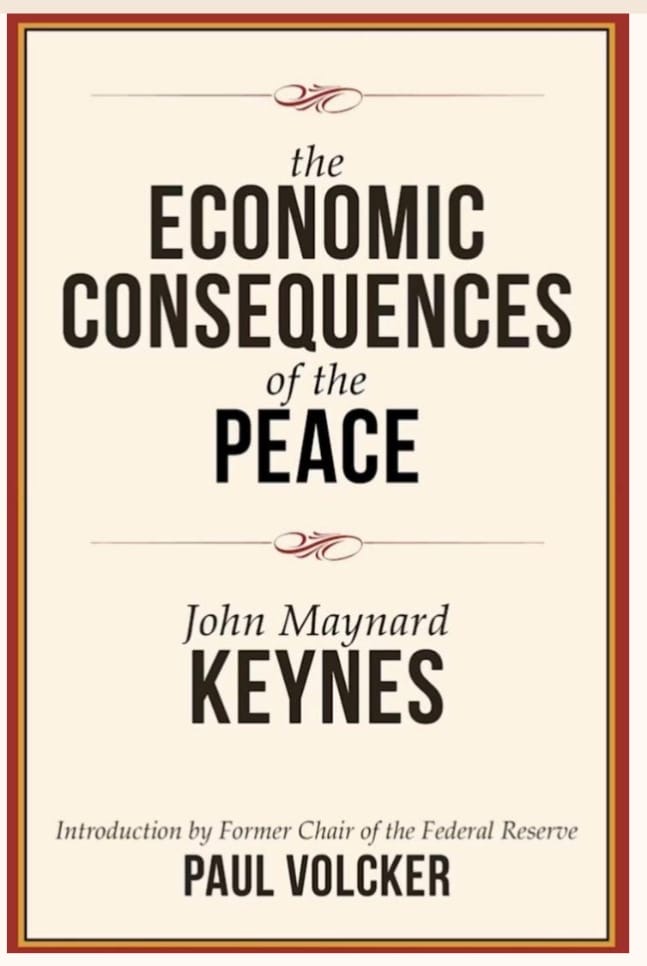
In 1919, Keynes wrote that polemic — The Economic Consequences of the Peace — a warning that the true cost of the Treaty of Versailles would not be paid at the signing table, but for years afterward, by economies nobody had bothered to examine while the ink dried.
The world was so consumed by the drama of the settlement that it missed the mechanism that would define the following decade.
2026’s Big Three
I want to draw the parallel out fully, because I think it is the whole point of this piece. Every generation produces its own version of the men Keynes sketched in Paris — leaders who took the world into a settlement, or a war, whose economic consequences they had not troubled themselves to calculate. In 1919 it was Wilson, Lloyd George, and Clemenceau. In 2026, I believe history will write the same chapter about Donald Trump and Benjamin Netanyahu.
I will say plainly what I think, because this is my platform and my view: this war was reckless and unnecessary. As far as America’s interests are concerned, I do not believe the United States had any business fighting it. Israel has its own agenda in the region, and Israel is entitled to pursue it — but America should never have placed itself in the position of prosecuting a war on Israel’s behalf, at American cost, with American forces, dragging the rest of the world into the economic wreckage that follows. This was not a war America needed to fight. It is a war America chose to fight, for reasons that had far more to do with Jerusalem’s strategic calculus than Washington’s.
Nor was Washington and Jerusalem alone in wanting this. The Gulf states that spent the run-up to this war quietly encouraging Trump toward confrontation with Iran — the UAE and Bahrain foremost among them — were not doing so out of concern for the American or the global economy. They were doing so because Iran is their regional rival, and a war that weakens Tehran serves Abu Dhabi’s and Manama’s interests regardless of what it costs everyone else. Small states pursuing their own security is understandable. What is less forgivable is a great power allowing itself to be walked into a war on someone else’s timetable and someone else’s grievance.
Keynes’s Big Three sat in Paris deciding the fate of Europe with, in his telling, more regard for politics than for the economics that would actually determine whether the peace held. Trump and Netanyahu, in my view, have done the 2026 equivalent — taking the decision to fight, with the encouragement of regional powers who had their own scores to settle, without pricing in what it would do to the rest of us. The Strategic Petroleum Reserve at sixteen days, the Bab al-Mandeb blockade, the insurance market repricing risk in real time — none of that featured in the calculation that started this. It rarely does, for the men who start these things. It is the rest of us who inherit the invoice.
We are making the same mistake now, in reverse. Everyone is watching the war. Almost no one is watching the buffer — and now almost no one is watching the second buffer either.
The Numbers That Matter
Since February, the world has been drawing down oil reserves it spent four decades accumulating. IEA member states held 4.1 billion barrels in strategic reserves in 2004. By 2026, that figure has fallen to 1.8 billion. The US Strategic Petroleum Reserve — 414 million barrels at the war’s outset — had fallen to roughly 316–320 million by mid-July, its lowest level since 1983. American crude inventories overall, reserve included, are at their lowest since 1984.
Put that in terms people can actually feel: at America’s total daily consumption of just over 20 million barrels a day, today’s Strategic Petroleum Reserve alone covers barely sixteen days. Sixteen days. That is the entire emergency margin behind the world’s largest economy — before commercial stockpiles and ordinary imports, which normally do the heavy lifting, have to carry the load on their own. This is not incidental. It is the entire reason the war has felt, to most people, survivable — so far.
Governments made a deliberate choice: burn the buffer, keep prices tolerable, buy time for diplomacy. The IEA itself coordinated the largest emergency release in its history — 400 million barrels — in March. It worked. Prices that could have spiralled were instead managed.
But a reserve is not a subsidy. It is a loan against the future, and the bill is now due. The IEA estimates that refilling what has been drawn down will require an extra one million barrels a day of supply, sustained, for three years — a claim on the market running through 2029. That is not a wartime cost. That is a peacetime cost, arriving after the guns fall silent, exactly as Keynes argued the costs of Versailles would.
Now overlay the second strait. If Bab al-Mandeb is genuinely constrained on top of Hormuz, the refill arithmetic gets worse, not just the current-flow arithmetic. Saudi Arabia loses its workaround at precisely the moment the world needs Saudi Arabia’s workaround most.
The Collision Nobody Is Pricing
Here is the trap. The refill has to happen at scale, which means sustained buying pressure on oil for the rest of the decade. At the same time, markets are expecting a return to surplus once the war ends. Cheap oil and an aggressive refill bid cannot coexist for long — every government rushing to rebuild its stockpile at once will bid up the very barrels it’s trying to buy cheaply. The floor under oil prices for the next three years is being set in storage tanks, not on a trading screen.
A two-strait closure changes the shape of that collision. It is no longer just a refill problem colliding with a surplus expectation. It is a live-supply problem — oil that cannot get to market today — colliding with a refill problem that assumes supply will be plentiful enough to spare for storage. Those two things were always going to be in tension. Now they are fighting over the same barrels at the same time.
What I See From the Insurance Market
I spent three and a half decades in marine war risk and P&I before any of this made headlines, and the insurance data tells the sharpest version of this story. Before the war, hull war-risk cover for a Hormuz transit cost roughly 0.1–0.15% of a vessel’s value — background noise. During the worst weeks, that spiked as high as 4% for seven days of cover on some routings — a 4,000-fold multiple on a single VLCC transit, turning a $150,000 cost into $5–7 million. Rates eased when the US–Iran MoU was signed in June. Then three vessels were attacked in Omani waters this month, two UAE supertankers were struck in the strait itself, and rates snapped back to roughly 5% as the new market norm.
That volatility is not a shipping story. It is a leading indicator. War risk premiums move days before oil prices catch up, because underwriters are pricing the war in real time, with their own capital, before anyone else has to. Right now they are telling you the ceasefire architecture is fragile and the reserve cushion behind it is nearly gone.
I expect Bab al-Mandeb rates to follow the same script Hormuz did, only faster. The market has now seen this movie once already this year. Underwriters do not need three months to relearn the lesson; they will reprice Red Sea and Gulf of Aden transits within days of confirming the Encelia and Layla attacks were real and not isolated. Watch that number. It will tell you what the shipping industry actually believes about how long this lasts, regardless of what any ceasefire statement says.
What This Means for the Price of Everything
This is where the story stops being about oil and starts being about you. A three-year refill bid of a million extra barrels a day, colliding with markets that expected relief once the shooting stopped, does not stay in the energy pages. It moves into diesel, into freight, into fertiliser, into the price of the food on the shelf and the electricity bill in the post. Every supply chain on earth still runs, in the end, on the price of a barrel of crude.
And it is landing on an economy that had no slack to begin with. Global growth going into this war was already sluggish — most major economies limping along on thin margins, high debt loads, and a decade of accumulated fragility. Layer a multi-year oil-price floor and a cost-of-living shock on top of that, and the honest question is no longer whether we are heading for a mild recession. It is whether the world has the reserves — financial as much as physical — to stop a downturn like this becoming something considerably deeper.
I do not say that to be alarmist. I say it because the people who priced the 4,000-fold jump in war-risk insurance premiums were not being alarmist either. They were simply the first to see what was coming. And this morning, with a second strait effectively joining the first, I think we need to update that assessment again — in the same direction.
The Peace Will Not Be Peace
When the war ends — and it will end — the headlines will move on. They always do. But the refill bid doesn’t end with the war. The insurance market’s memory doesn’t reset with a ceasefire. The Strategic Petroleum Reserve’s physical withdrawal infrastructure, built in the 1970s for a 25-year lifespan and now pushed well past it, doesn’t repair itself. And a blockade that has already demonstrated it can turn back six tankers without firing a shot does not simply dissolve because a separate ceasefire is signed in a separate strait.
Keynes’s argument was never really about Versailles. It was about the danger of a world that mistakes the signing of an agreement for the resolution of its underlying economics. We are about to make exactly that mistake again — celebrating a ceasefire while the real invoice, three years long and running through 2029, quietly gets mailed to every economy that depends on oil. Except now there are two invoices, from two straits, and I am not yet convinced either government involved has fully understood that the other one exists.
The war will end. The economic consequences of the war will not.
– Lim Tean, The Great Game