


Letters from Stockholm
By Kio Amachree
There is a phrase that has followed me my entire life, spoken in markets and ministries alike, half in admiration and half in warning: power is sweet. It is one of the most dangerous sentences in our national vocabulary. It contains, in three words, the whole disease.
Because in Nigeria power has never been widely understood as a trust, something borrowed briefly from other people, to be handed back intact. It is understood as a harvest. A season. Your turn. And when a man believes it is his turn, he does not govern. He gathers.
I write this from Stockholm, and I want to say plainly what the distance has made unbearably clear to me. We are not being destroyed by our enemies. We are being destroyed by the people we trusted, and by a culture that still, even now, congratulates them.
The Arithmetic of Contempt
Look at the numbers, because the numbers do not lecture. They simply state.
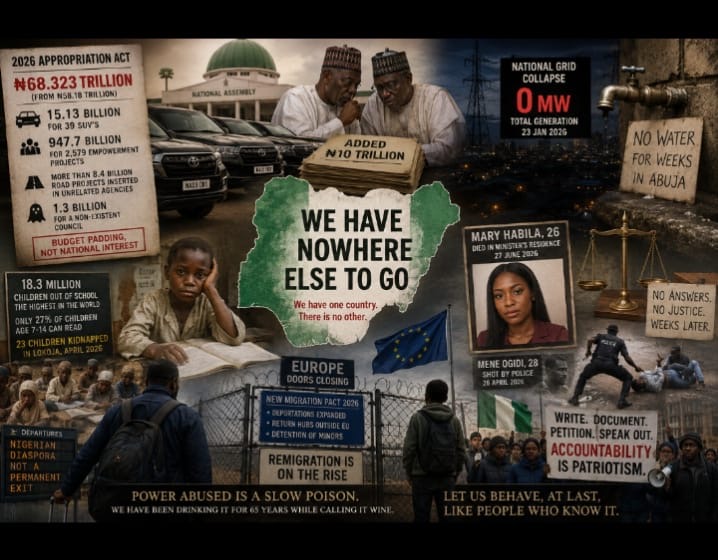
The 2026 Appropriation Bill went to the National Assembly at 58.18 trillion naira. It came back at 68.323 trillion naira and was signed into law on 31 March 2026. Ten trillion naira, added by legislators, to a budget already running a deficit of roughly forty six per cent, money the country does not have and must borrow, with debt financing revised upward to some 29.2 trillion naira.
What did that ten trillion buy?
The civic monitoring group Tracka went through the documents line by line. It found 15.13 billion naira allocated for thirty nine sport utility vehicles, and 947.7 billion naira for 2,579 so called empowerment projects. Together, 962.83 billion naira, more than the combined 960.27 billion naira allocated to seven federal ministries: Trade and Investment, Housing, Women Affairs, Justice, Livestock Development, Aviation, and Petroleum Resources.
Of those 2,579 empowerment projects, only seventy have a clearly identified location. Seventy. The rest is money released into fog.
Then there is the small matter of the Presidential Foreign Intervention Promotion Council, to which 1.3 billion naira was appropriated in the 2026 Act. It does not exist. A phantom body, funded from the sweat of people queuing for kerosene.
And the Almajiri and Out of School Children Education Commission, an agency created for the poorest children in the Federation, was found carrying a 1.4 billion naira road project in Ogun State, part of some 8.4 billion naira in road allocations inserted into the budget of a body with no road building mandate whatsoever. Femi Falana, SAN, called it what it is: budget padding. He also said the quiet part aloud, that it persists because the President allows it.
This is not incompetence. Incompetence is accidental. This is design.
In June 2026 the Federal High Court in Lagos, Justice Yellim Bogoro presiding, declared the National Assembly’s 110 billion naira vehicle and allowance scheme unlawful, 40 billion naira for 465 bulletproof SUVs and 70 billion naira in support allowances, in a suit brought by SERAP against the Senate President and the Speaker. The court held that spending public money on luxury vehicles while millions cannot eat was a failure to prioritise the national interest.
The National Assembly’s response was to explain that the Land Cruisers are for constituency work.
That is where we are. Not shame. Not resignation. Explanation.
Darkness in the Capital, and Dry Taps in Maitama
On the morning of 23 January 2026 the national grid collapsed. Not partially. Total generation fell to zero megawatts. Every one of the eleven distribution companies, Abuja, Benin, Eko, Enugu, Ibadan, Ikeja, Jos, Kaduna, Kano, Port Harcourt and Yola, recorded nothing. Four days later it happened again. It had happened on 29 December 2025. It has happened, in one form or another, year after year after year.
And yet in Aba, Abia State, a city of some nine hundred thousand people, the lights stayed on. Geometric Power’s 188 megawatt plant, its own distribution network, its own smart meters. An island of ordinary competence in an ocean of national failure, proving definitively that this is not a curse, not a climate, not a colonial inheritance. It is a choice, and other Nigerians have made the opposite choice successfully, in Nigeria, with Nigerians.
Now consider water. In January 2026 the Abuja Electricity Distribution Company disconnected the FCT Water Board from power over unpaid bills. The FCT Administration, the government of the Federal Capital Territory, could not pay its electricity bill. The Lower Usuma Dam stopped operating. Taps went dry across the capital of the Federal Republic.
By March, residents of Ushafa, Bwari and Dutse had gone weeks without water. By May, communities along the Airport Road corridor, Lugbe, Aco Estate, Goza and Sauka, reported taps dry for months. This August, residents of Wuse Zones 1, 2 and 3 and Wuse II are appealing publicly to the Minister after nearly three weeks without supply, buying from vendors at prices that rise every day.
All of this in a city where a 470 million dollar Greater Abuja Water Supply Project was commissioned with cameras and speeches in June 2025.
We have mastered the ribbon and forgotten the pipe.
A Young Woman Died, and the Country Still Does Not Know How
On 27 June 2026, Mary Habila, twenty six years old, died inside the compound of the country home of the Minister of Works in Uburu, Ebonyi State.
I make no accusation. I do not know what happened in that room, and neither does anyone else outside it, and that is precisely the point. The Director of Public Prosecutions advised that a post mortem was essential, noting there was no evidence she was unwell before her sudden death. The police insisted on it. The Minister has publicly stated he supports an autopsy, described her as being like a daughter to him, and offered his account of a nosebleed. Her family, citing cultural reasons, opposed the examination, and were reduced to petitioning the Inspector General of Police to release their daughter’s body for burial.
Weeks passed. Photographs circulated. Nothing was settled.
That is the scandal. Not a verdict, but the absence of any machinery capable of producing one. A young Nigerian woman can die in proximity to power in this country and the state cannot reliably tell her mother why. Two months later, we still do not have a clean, credible, independent answer. In a functioning republic that answer would have taken eleven days and would not have depended on who the deceased happened to be standing next to.
And she is not alone. On 26 April 2026 in Effurun, Delta State, Mene Ogidi, twenty eight, was restrained on the ground and shot at close range by an Assistant Superintendent of Police. We know his name only because a stranger held up a phone. How many have no stranger, and no phone?
What the Abuse Costs, Measured in Children
Nigeria has 18.3 million children out of school, the highest number on earth. UNICEF puts the figure of children and adolescents without access to formal schooling or digital learning at more than 28 million. Only about twenty seven per cent of children between seven and fourteen have basic reading skills. And in this same 2026 budget, education’s share fell from the previous year.
Between June 2025 and May 2026, more than 14,500 people died in conflict related violence, placing Nigeria fourth in the world on the Global Terrorism Index. On 26 April 2026 gunmen took twenty three children from an orphanage near Lokoja.
Set that against 15.13 billion naira for thirty nine motor cars.
That is the exchange rate of our governance. That is what a stolen trust actually purchases: a generation that cannot read, in a country that cannot protect them, financed by debt they will inherit.
The Door Behind Us Is Closing
Here is why I am writing this now, and why I am writing it with urgency rather than elegance.
For sixty years, the escape valve for Nigerian ambition has been departure. When the country failed you, you left. Europe took you. America took you. That door is closing, and it is closing fast.
In February 2026 the European Union voted to allow the deportation of asylum seekers to safe third countries with which they have no connection whatsoever. In June the Pact on Migration and Asylum came into force, and a further agreement legalised return hubs outside the Union and the detention of minors. Germany’s Interior Minister has spoken of commissioning return hubs before the end of this year, with African countries under discussion. The Netherlands has already concluded an arrangement with Uganda.
Meanwhile a word that was fringe when I first heard it, remigration, the mass deportation of non white people regardless of citizenship status, now appears in far right manifestos across Europe and has its own annual summit, most recently on 30 May 2026.
I live in Europe. I have watched this hardening arrive year by year, in the tone of a bus driver, in the language of a parliamentary debate, in the way a policeman looks at a boy in Rinkeby. Africans are being made the symbol of everything Europe fears about itself.
So understand what this means. The diaspora is not a permanent exit. It is a shrinking room. Whatever passport we carry, whatever tax we pay, whatever decades we have given, there is one country on this earth that can never deport us, and it is Nigeria.
That is not sentiment. That is strategy. We have precisely one homeland, and men who cannot pay an electricity bill are running it into the ground.
There Will Be No Break Up
Let me be unambiguous, because I know where this argument usually goes.
Nigeria will not break up. It is not going to happen. I say this not as a loyalist but as a realist. Every serious model of dissolution ends the same way, not in three or six orderly republics, but in a decade of contested borders, stranded minorities, collapsed currency, ruined trade, and armed men filling the vacuum. And the people who would suffer most are precisely those who suffer most now. The Niger Delta child, the Almajiri, the market woman in Onitsha, the widow in Maiduguri.
Break up is the fantasy of men who imagine they would be on the winning side of it. There is no winning side of it.
The work is not secession. The work is repair. We must improve the Nigeria we actually have, for children who will actually live in it, learning honestly from what we got wrong. Anything else is a daydream that costs blood.
What Must Be Done
I do not believe in complaint without prescription. So let me state a minimum programme, modest, specific, and achievable within a single term by any government that wanted to.
One. Consequence, not recovery. Asset recovery figures are announced with fanfare every year while politically exposed persons are almost never convicted. Recovery without prosecution is simply a tax on theft. Nigeria needs a genuinely independent prosecutorial office for public sector corruption, with security of tenure, budgetary independence from the National Assembly it must investigate, and a published register of every case above one billion naira with its status updated quarterly.
Two. Kill the padding. Every insertion into an agency budget by a legislator should be published, by name, with the sponsoring member identified, within seven days of insertion. Sunlight costs nothing. It is the cheapest reform available to us and the one most fiercely resisted, which tells you exactly how well it would work.
Three. Replicate Aba, do not repair the grid. Nigeria should stop pretending it will fix a national transmission system it has failed to fix for forty years. Decentralise. Licence and finance municipal and regional generation on the Geometric model, city by city, with guaranteed cost reflective tariffs and ring fenced revenues. Twenty Abas would transform this country faster than any single federal project.
Four. Autopsy as a right. No death occurring on the premises of a public official should be closed without an independent forensic post mortem conducted outside the jurisdiction where the official holds influence, with the report published. Not to persecute anyone. To protect everyone, including the innocent official, who is entitled to be cleared by evidence rather than by silence.
Five. Diaspora as instrument, not remittance machine. Nigerians abroad send home tens of billions of dollars a year and are treated as an ATM with a voice they are not permitted to use. Diaspora voting, diaspora bonds tied to audited municipal water and power projects, and a standing diaspora accountability office with real reporting powers. We have engineers at Sweco and AFRY, lawyers in the Inns of Court, physicians in Houston, financiers in Zurich. Use us, or lose us permanently to societies that are already deciding they no longer want us.
To My Brothers and Sisters Abroad
I am driven by something I cannot fully explain and have stopped trying to. Call it inheritance. My father served this country when service still meant something, when a Nigerian could stand in a room in New York or London and be the most serious person in it. I have spent years now setting down a record of what is being done to that inheritance, and I will go on doing it.
But I cannot do it alone, and neither can any of us.
To every Nigerian in Stockholm, London, Houston, Toronto, Johannesburg and Dubai, the fight is not optional any longer, and it is not charity. It is self defence. The clouds over Nigeria are darkening, Europe is bolting its doors, and the men holding our trust are buying tyres for bulletproof convoys while a nurse’s family begs for her body and a child in Sokoto has never held a book.
Enough. Write. Document. Petition. Fund the journalists. Name the accounts. Support the courts when they rule against the powerful, as one did in June. Refuse the invitation to celebrate the man who has made it without asking what he made it from. That celebration, that quiet, cultural, universal Nigerian applause for the successful thief, is the deepest root of the whole catastrophe, and it lives not only in Abuja but in our own living rooms in the diaspora.
Power abused is not sweet. It is a slow poison, and we have been drinking it for sixty five years while calling it wine.
We have one country. There is no other. Let us behave, at last, like people who know it.
– Kio Amachree is Founder and President of Worldview International.